The quick answer
- Short bursts of heat (a home office, a cold bedroom before bed): a ceramic fan heater warms you within minutes.
- Heating a room for hours (living room, all evening): an oil-filled radiator gives gentle, silent, even heat.
- Efficiency: every plug-in electric heater turns 100% of its electricity into heat. No type is “cheaper per hour” at the same wattage; the saving comes from heating only the room you use.
- Running cost: a 2 kW heater costs up to €0.56 an hour at full power (€0.28/kWh EU average). A thermostat cuts this once the room is warm.
- Not sure? See our picks by room.

This is the time of year people start thinking about heating. Whether you want to make your living room nice and toasty or add extra warmth to your baby’s room, a portable heater is a simple, flexible way to stay warm.
A European winter can be very cold: as the nights draw in and the thermometer drops, it gets chilly indoors. Most of us have gas or electric central heating, but energy costs have risen, and turning the thermostat up even a few degrees can add a lot to your monthly bill. A portable heater lets you keep the room you’re in warm without heating the whole house.
1Why use a portable heater?
People use portable heaters in living rooms, children’s bedrooms, home offices, sheds, garden rooms and shops: pretty much anywhere that needs a boost of warmth. Here are the most common benefits:
Heat just the room you’re in
Turn the central heating down, or off when you only use one or two rooms, and heat just where you are. Stay warm without shivering through cold winter evenings. When it saves money.
They don’t take up much room
No bulky appliance or installation. Portable heaters come in all shapes and sizes, so you can bring warmth into even the smallest space.
Move it room to room
Bedroom tonight, lounge tomorrow, home office next week? Just unplug it and take it with you. Many heaters have wheels and handles to make it even easier.
A small initial investment
For less than the price of a pub meal you can buy a mini ceramic heater that keeps you toasty: our 500W personal heater costs less than a takeaway. Few appliances can change your whole winter for so little.
Banish cold spots
You don’t have to heat the entire space. A heater in a draughty corner evens out cold spots, for a comfortable, balanced home without hot and cold pockets.
Warmth when you want it
A fan heater feels warm within minutes. On models with an off timer, you can set the length of a heating session.
2Fan heater vs oil-filled radiator vs convector
The right electric heater depends on how quickly you want heat, how long you’ll run it and whether noise matters. Here’s how the main types compare.
| Type | Heats up | Best for | Noise | Holds heat |
|---|---|---|---|---|
| Ceramic fan heater | Within minutes | Quick warmth, small rooms, desks | Fan hum | No |
| Oil-filled radiator | Slower | Whole rooms for long periods | Near-silent | Yes, for a while |
| Convector / panel | Medium | Background room heat | Quiet | No |
| Halogen / infrared | Instant | Warming people, patios | Silent | No |
3Fan heaters
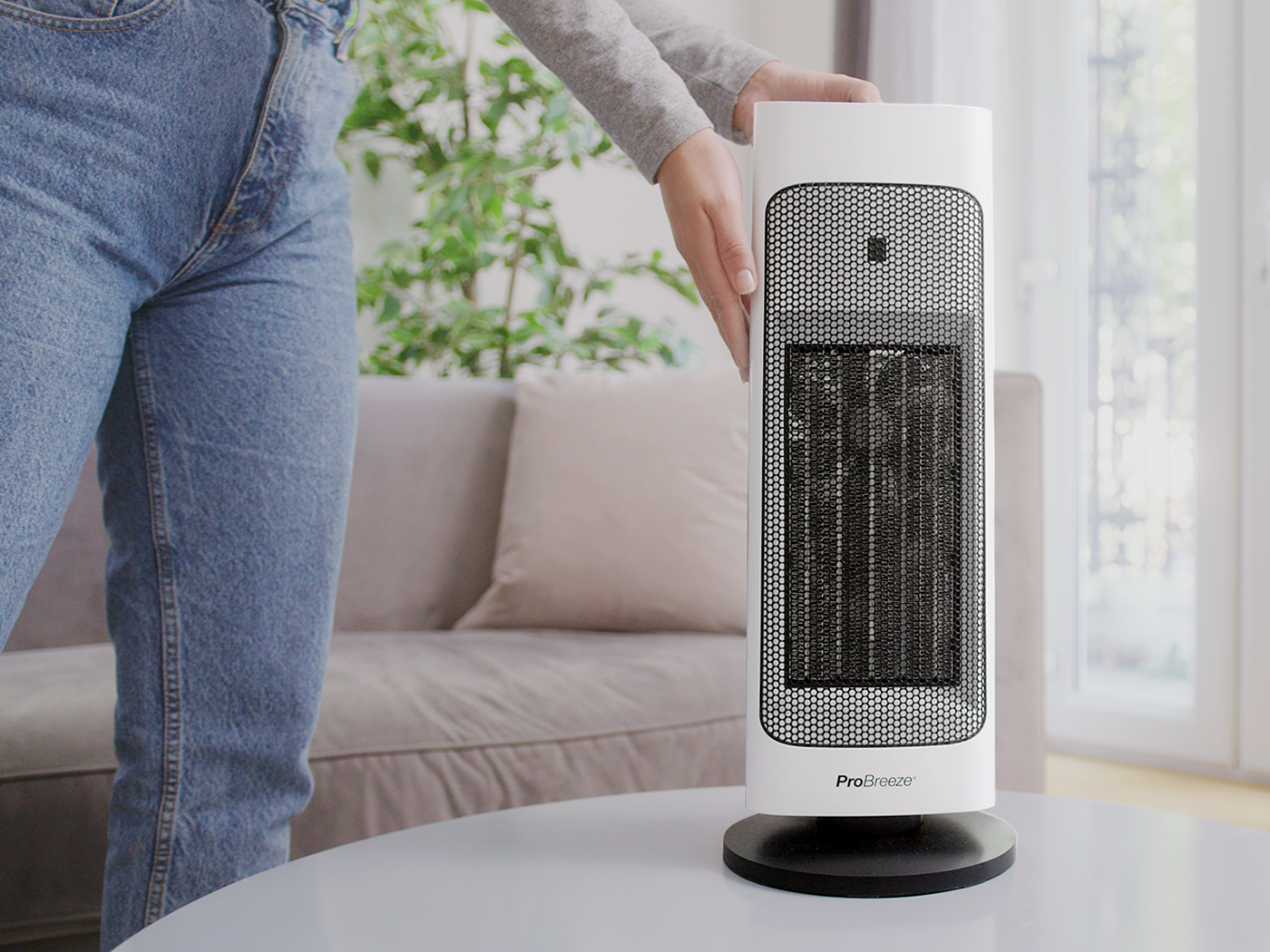
A fan heater draws air in, heats it rapidly over an element and blows warm air out into the room. The size and power of the fan decide how much of the room it heats, and how quickly. You can get fan heaters with ceramic or metal-coil elements. Most modern models use a ceramic (PTC) element as a safety measure: it limits its own temperature, typically staying below about 200°C, whereas a metal coil glows red hot. That reduces the risk of burns and fire.
- Warm you within minutes
- Blow heat exactly where you need it, even straight at your feet
- Small, light and easy to move
- Cheapest to buy
- Oscillation spreads heat around the room
- Room cools quickly once switched off
- Fan noise (check the dB rating for bedrooms)

Best for: home offices, bedrooms before bed, heating one section of a room and anywhere you need heat fast for an hour or two. Typical price: about €15–€70; Pro Breeze ceramic fan heaters are great value, especially in our sales. Shop fan heaters.
4Oil-filled radiators
Despite the name, you don’t fill these heaters with oil to make them work. An electric element heats oil sealed inside the fins, and you never top it up. The hot fins warm the air near them, which then circulates evenly through the room. If you want to heat a whole room for a prolonged period, this is the one to choose.
- Gentle, even heat across a whole room
- No fan, so almost silent: good for bedrooms
- Stays warm for a while after switching off
- Timers let you set it to start a few hours before you need the heat
- Takes longer to warm up
- Heavier (around 8–11 kg), though on wheels

Keeping warm after switch-off doesn’t make a radiator cheaper overall: the oil gives back heat it has already used electricity to make. It does make the heat feel steadier and more comfortable. Typical price: about €20–€200; Pro Breeze 2500W radiators are great value, especially in our sales. Shop oil-filled radiators.
5Convector and panel heaters
Convectors heat air over an element; the warm air rises and draws cooler air in behind it, slowly circulating heat around the room. They can take a while to reach full heat, but are ideal for larger rooms and long periods of use (typical price about €20–€100). Panel heaters are slim convectors designed to fix to a wall, saving floor space and working much like a radiator (typically €40–€200). They suit background heat in rooms used regularly, but warm up more slowly than a fan heater and don’t hold heat like an oil-filled radiator. Pro Breeze doesn’t currently sell convector heaters; for similar quiet, whole-room heat, an oil-filled radiator is the closest choice.
6Halogen and infrared heaters
These heat people and objects directly, like sunshine, rather than warming the air. That makes them instant, and useful outdoors or in draughty spaces where warm air would blow away. Halogen heaters use halogen bulbs instead of a coil and are among the cheapest to buy (typically about €10–€50). Radiant heaters work best for targeted warmth in a particular spot. Follow the instructions in your product’s manual. For patios and balconies, see our wall-mounted infrared patio heater.
7How much does an electric heater cost to run?
Running cost depends only on wattage and how long the heater is drawing power. Multiply the kilowatts by your electricity price.
| Heater | Type | Max power | Per hour* | 4 hours a day for a week* |
|---|---|---|---|---|
| 500W Personal Heater | Ceramic fan | 500 W | €0.14 | €3.92 |
| ThermaCube Mini | Ceramic fan | 1,500 W | €0.42 | €11.76 |
| 1800W Circular Heater | Ceramic fan | 1,800 W | €0.50 | €14.11 |
| ThermaCube 2000W | Ceramic fan | 2,000 W | €0.56 | €15.68 |
| ThermaCube Plus | Ceramic fan | 2,200 W | €0.62 | €17.25 |
| OmniWarm 2500W | Oil-filled | 2,500 W | €0.70 | €19.60 |
*Costs at full power, at €0.28 per kWh: the Eurostat EU average electricity price for households (2026 first half, including taxes). Real costs are usually lower: once the room reaches the temperature you set, the thermostat switches the element off and on, and many heaters have lower power settings.
Electricity rates vary across Europe (Eurostat, 2026-S1, household average including taxes):
| Country | Price per kWh |
|---|---|
| Ireland | €0.39 |
| Germany | €0.36 |
| Belgium | €0.36 |
| Austria | €0.33 |
| Italy | €0.31 |
| Poland | €0.30 |
| Czechia | €0.29 |
| Spain | €0.25 |
| France | €0.25 |
| Netherlands | €0.24 |
| Portugal | €0.24 |
8Which electric heater costs least to run?
Heat output is the same for every electric heater: a 2 kW fan heater, a 2 kW radiator and a 2 kW tower all turn 2 kW of electricity into 2 kW of heat. That means the model isn’t what changes your bill. Three things do: the wattage you choose, whether a thermostat switches the heater off once the room is warm, and how many hours it runs. The cheapest choice is the right size for the room, used with a thermostat and a timer. An oil-filled radiator also keeps giving out heat for a while after it switches off, so the room stays comfortable between cycles; it doesn’t change how much electricity was used to heat it.
Here is the Pro Breeze UK electric heater range. Running costs are at full power. Use the “4-hour evening” column to compare them; a thermostat will usually bring the real figure lower.
| Heater | Type | Max power | Per hour* | 4-hour evening* |
|---|---|---|---|---|
| 500W Personal Heater | Ceramic fan | 500 W | €0.14 | €0.56 |
| ThermaCube Mini 1500W | Ceramic fan | 1,500 W | €0.42 | €1.68 |
| 1800W Circular Heater | Ceramic fan | 1,800 W | €0.50 | €2.02 |
| 1800W Mini Heater | Ceramic fan | 1,800 W | €0.50 | €2.02 |
| 2000W Mini Heater, black | Ceramic fan | 2,000 W | €0.56 | €2.24 |
| 2000W Mini Heater, white | Ceramic fan | 2,000 W | €0.56 | €2.24 |
| 2000W Mini Heater with Oscillation | Ceramic fan | 2,000 W | €0.56 | €2.24 |
| 2000W Ceramic PTC Tower Heater | Ceramic tower fan | 2,000 W | €0.56 | €2.24 |
| ThermaCube 2000W | Ceramic fan | 2,000 W | €0.56 | €2.24 |
| Wall Mounted Infrared Patio Heater | Infrared | 2,000 W | €0.56 | €2.24 |
| ThermaCube Plus 2200W | Ceramic tower fan | 2,200 W | €0.62 | €2.46 |
| 2500W Compact Radiator, white | Oil-filled | 2,500 W | €0.70 | €2.80 |
| 2500W Radiator with Thermostat, black | Oil-filled | 2,500 W | €0.70 | €2.80 |
| 2500W Radiator, white | Oil-filled | 2,500 W | €0.70 | €2.80 |
| 2500W Radiator, black | Oil-filled | 2,500 W | €0.70 | €2.80 |
| OmniWarm 2500W, white | Oil-filled | 2,500 W | €0.70 | €2.80 |
| OmniWarm 2500W, black | Oil-filled | 2,500 W | €0.70 | €2.80 |
| OmniWarm 2500W Smart, white | Oil-filled | 2,500 W | €0.70 | €2.80 |
| OmniWarm 2500W Smart, black | Oil-filled | 2,500 W | €0.70 | €2.80 |
| OmniWarm 2500W Smart, silver | Oil-filled | 2,500 W | €0.70 | €2.80 |
*Maximum power from each product’s specification, multiplied by €0.28 per kWh: the Eurostat EU average electricity price for household consumers (2026-S1). Thermostat and low-power settings reduce real costs, and local electricity rates vary across Europe.
Which one for which room?
Desk or personal space
The 500W Personal Heater warms you rather than the room, for €0.14 an hour at full power. The lowest running cost of any Pro Breeze heater.
Bedroom
Quiet matters most. The ThermaCube Mini 1500W runs from 40.8 dB with a 12-hour timer, and an oil-filled radiator has no fan at all. An off timer controls the length of a heating session.
Living room
For long evenings, the OmniWarm 2500W radiator gives steady heat for rooms up to 30 m². For quick warmth, the ThermaCube 2000W heats up within minutes.
Conservatory or garden room
Glass and thin walls lose heat fast, so go up a size: the ThermaCube Plus 2200W for quick heat, or a 2500W radiator with a thermostat for longer stays. Insulation makes the biggest difference.
Heating outdoors? The wall-mounted infrared patio heater warms people directly rather than the air around them.
9Can a portable heater save you money?
Some of us have thermostats that set each room separately, but many home heating systems are “all or nothing”: you heat the whole house even if you’re only using one room. A portable heater can warm the room you’re using, which can help cut the cost of heating the rest of the house.
So yes, a portable heater can save you money, as long as it lets you heat less of your home. Across the EU, electricity averages around €0.28 per kWh and natural gas around €0.11 per kWh (Eurostat), so each unit of heat from a plug-in heater costs over twice as much as mains gas. Using an electric heater as well as gas central heating will raise your bills.
- Good use: you work from home in one room. Turn the central heating down or off and heat just the office.
- Good use: a cold spare room, conservatory or garden office that the central heating doesn’t reach.
- Poor use: running several heaters to warm the whole house when you have gas central heating.
If your home has electric-only heating, a portable heater with a good thermostat and timer can still help by heating only the rooms you use, when you use them.
10What size heater do you need?
The most important factor is the size of the space you want to heat: the larger the room, the more powerful the heater you need. Most heaters list the room size they suit, and as a guide from our product specifications:
| Space | Typical power | Good choice |
|---|---|---|
| Desk or personal use | 500 W | Personal ceramic heater |
| Small room, up to about 15 m² | 1.5–2 kW | Mini ceramic fan heater |
| Rooms up to about 30 m² | 1.8–2.5 kW | ThermaCube or oil-filled radiator |
Draughty or poorly insulated rooms, high ceilings and conservatories need more. A heater that’s too small will run flat out without getting the room warm.
Whole room or one spot? To heat an entire room, an oil-filled radiator warms the air and circulates it evenly through the space. To heat one area, such as your desk or your feet, a ceramic fan heater makes more sense.
11Features worth looking for
Adjustable thermostat
Keeps your room at the temperature you choose: it cuts the power once the room is warm and switches back on when it cools, which also saves energy. The single biggest money-saver.
Programmable timer
A built-in off timer lets you set the length of a heating session. Follow the instructions in your product’s manual.
Heat settings and eco mode
Two or three heat settings, plus an eco mode on some models, let you use lower power and less electricity when you don’t need full heat.
Wheels and handles
If you’ll move it from room to room, choose a lighter model, or one with wheels and a carry handle.
Tip-over and overheat cut-off
Switches off if knocked over or too hot. Essential with children and pets.
Low noise
For bedrooms, and especially a baby’s room, you’ll want it as quiet as possible: choose an oil-filled radiator or a quiet fan heater. Our ThermaCube range runs from 40.8 dB. In a busy living area, noise matters less.
Oscillation
Just like a cooling fan, a fan heater that turns side to side spreads warmth evenly around a larger room.
Remote and app control
Change the heat and fan settings from across the room, or from your phone on smart models.
12Using a heater safely
Whenever you bring a new appliance into your home, safety comes first. Look for a heater with a tip-over switch, overheat protection, an automatic thermostat and guards that keep little fingers away from hot parts. Every Pro Breeze portable heater has overheat protection and a tip-over switch. Never hesitate to do a little extra research on safety. Then follow the manual, and this advice from the charity Electrical Safety First:
- Keep the heater at least 1 metre from curtains, furniture, bedding and paper.
- Plug it straight into a wall socket, not an extension lead, which can overload.
- Stand it on a flat, level surface.
- Never dry clothes on or near a heater.
- If your model has an off timer, it switches the heater off after the interval you select. Follow the instructions in your product’s manual.
- Buy from a reputable retailer and register it, so you hear about any recall.
13Frequently asked questions
Are oil-filled radiators better than fan heaters?
For long, quiet, whole-room heating, yes. For quick warmth in a small space, a fan heater is better. Neither is more efficient at the same wattage.
Are oil-filled radiators more efficient than fan heaters?
No. Both turn all the electricity they use into heat. A radiator holds heat after switching off, which makes it feel steadier, but it used electricity to store that heat in the first place.
What is the cheapest electric heater to run?
The lowest-wattage heater that keeps you comfortable, used with a thermostat and timer, in the room you’re actually in. A 500 W personal heater at your desk costs about a quarter as much per hour as a 2 kW heater.
What’s the best heater for a baby’s room or nursery?
Many parents choose an oil-filled radiator: it has no fan, so it’s almost silent, and gives gentle, even heat. Pick one with a thermostat and timer so you can warm the room before bedtime, keep it at least a metre from the cot, bedding and curtains, and out of reach of little hands.
What’s the best heater for a shed, garage or garden office?
For quick warmth while you work, a ceramic fan heater heats you up within minutes. For a garden office you use all day, an oil-filled radiator with a thermostat keeps the space comfortably warm. Insulation makes a big difference in outbuildings.
Are portable heaters cheaper than central heating?
Per unit of heat, gas central heating is cheaper. A portable heater saves money when it lets you turn the central heating down and heat only the room you’re using. See can a portable heater save you money?
How do the thermostat and timer work on an oil-filled radiator?
A thermostat cycles the heater to maintain your chosen temperature. If your model has an off timer, it switches the radiator off after the interval you select. Follow the instructions in your product’s manual.
14Which Pro Breeze heater should you buy?


OmniWarm 2500W Oil Filled 11 Fins Eco Radiator Heater With Digital Display - White
1 706,00 kr
View product

Compare every model on our heaters page. Battling damp as well as cold? Read our 13-step guide to buying a dehumidifier.