The quick answer
- Match the purifier to your room. Multiply floor area by ceiling height, then choose a CADR (clean air delivery rate) that gives at least 2 air changes an hour, or 4 if you are buying with allergies or asthma in mind. A 4 m × 3.5 m bedroom needs about 134 m³/h for 4 changes an hour.
- Look for a true HEPA filter (H13). H13 is tested to capture at least 99.95% of particles at the most penetrating particle size, including dust, pollen and pet dander. Pro Breeze specifies AeraDry’s filter as capturing 99.95% at 0.3 microns. Add activated carbon if smoke or cooking smells are the problem.
- Check the running costs before you buy: noise, power and the price of replacement filters. Our bladeless fan purifiers cost around 1c an hour to run, and the AeraDry 25L 2-in-1 costs about €0.10 an hour at its rated dehumidifying power.
- An air purifier cleans the air; it does not remove moisture. If condensation, damp or drying washing is part of the picture, you need a dehumidifier too, and the AeraDry does both jobs in one machine.
- Jump to the Pro Breeze options.

Choosing an air purifier can feel daunting when every box promises cleaner air. Where do you start? Our team at Pro Breeze has put together this seven-step guide to help you choose one that suits your home: what an air purifier does, which filters matter, how to size one for your room, and what it will really cost to run. Cleaner air in the room you spend the most time in is closer than you think.
1What an air purifier does (and what it doesn’t)
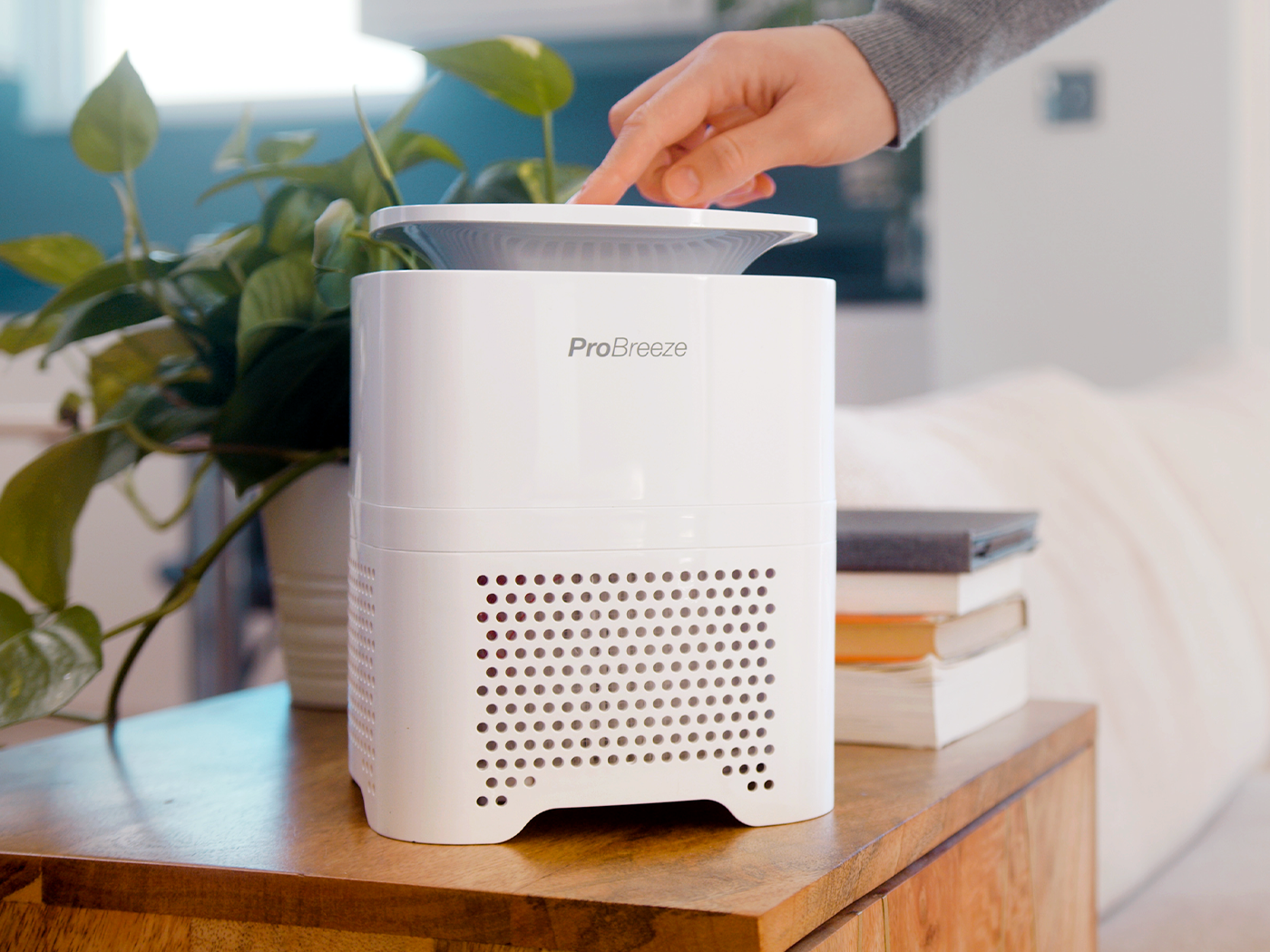
An air purifier (sometimes called an “air cleaner”) is a device that draws room air through one or more filters and sends cleaner air back out. Most are portable units for a single room; larger systems can work alongside a home’s ventilation. The particles an air purifier can help remove from the air include:
- Dust and the dust mite particles that travel with it
- Pollen and other allergens, for a calmer hay fever season
- Pet dander and hair
- Tobacco smoke and cooking smoke (with a carbon filter, the smell too)
- Airborne mould spores (see the note below on mould)
- Everyday environmental pollution that drifts in from outside
2What do you want it to remove?
Most people buy an air purifier for one of these reasons. Decide which matters most to you, because it points you to the filters to look for.
- Allergies and hay fever: to reduce triggers such as pollen and dust. Customers with allergies often tell us they notice the difference first in the bedroom.
- Less dust to clean: catching fine dust before it settles on shelves and surfaces.
- Mould spores and mildew: a HEPA filter captures spores that are floating in the air. To stop mould growing in the first place you need to control humidity (see the warning above).
- Smells: cooking, pets and everyday household odours.
- Pet dander: if you share your home with a dog or cat.
- Smoke and other gases: from cooking, candles, a log burner or a smoker in the household.
| Your priority | Filters to look for |
|---|---|
| Asthma and allergy triggers | HEPA with activated carbon |
| Pet allergies and hay fever | HEPA, plus a pre-filter to catch pet hair |
| Mould spores and bacteria | HEPA (UV light is an optional extra) |
| Smoke | HEPA with activated carbon |
| Odours | HEPA with activated carbon |
| Children’s rooms | HEPA, cold catalyst and activated carbon (UV light optional) |
These are the filter combinations most often recommended for each need. An air purifier supports a clean home; it does not replace cleaning, ventilation or medical advice.
3Air purifier filters explained
The filter is the heart of the machine. Here is what each type does, so you can compare like with like.
| Filter | What it does | Good to know |
|---|---|---|
| Pre-filter | Catches large particles such as dust and pet hair before they reach the main filter. | Protects the HEPA filter and extends its life. Check and clean it regularly. |
| HEPA | A dense mat of fine fibres that traps tiny particles: dust, pollen, pet dander, mould spores and smoke particles. | The filter that matters most. Look for “true HEPA”, grade H13. |
| Activated carbon | Absorbs odours, vapours and gases into its tiny pores. | Needed for smoke and cooking smells: HEPA alone catches particles, not gases. |
| Ionic (negative ion) | Releases charged ions that bind to particles so they fall to the floor or onto a collection plate. | An optional extra. Some ioniser designs can produce small amounts of ozone, so check the manual. |
| Cold catalyst | Absorbs and breaks down formaldehyde and tiny floating dust particles, and helps with gases such as benzene, ammonia and TVOCs. | Useful for new furniture and decorating, which can release gases. |
| UV light | Light inside the unit that disrupts the DNA of pathogens passing through (the light does not shine into the room). | An optional extra; it works alongside a HEPA filter, not instead of one. |
Other sources include decorating dust, household cleaners, solvents, pesticides carried indoors and gases released by new furnishings; the right filter depends on the pollutant.
4Room size, CADR and air changes: choose the right size
Measure the room you will use it in (floor area and ceiling height), then match that to a purifier’s clean air delivery rate. Two ratings do the work:
- CADR (Clean Air Delivery Rate) is the volume of clean air the purifier delivers, in cubic metres per hour (m³/h). It was created by the Association of Home Appliance Manufacturers (AHAM). The higher the number, the faster it cleans the air.
- ACH (Air Changes per Hour) tells you how many times an hour the purifier exchanges all of the air in the room. An ACH of 4 means the whole volume of air passes through the filters four times an hour. We recommend at least 4 if the purifier is for someone with allergies or asthma, and 2 is a sensible minimum for general freshening.
For example, a 4 m × 3.5 m bedroom (14 m²) with a 2.4 m ceiling has a volume of about 34 m³. For 4 air changes an hour you need a CADR of about 134 m³/h; for 2 changes an hour, about 67 m³/h. The table shows the same sum for common room sizes, using a 2.4 m ceiling.
| Room | Floor area | Volume | CADR for 2 changes/hour | CADR for 4 changes/hour |
|---|---|---|---|---|
| Small bedroom or home office | 10 m² | 24 m³ | 48 m³/h | 96 m³/h |
| Double bedroom | 15 m² | 36 m³ | 72 m³/h | 144 m³/h |
| Large bedroom or living room | 20 m² | 48 m³ | 96 m³/h | 192 m³/h |
| Open-plan living space | 30 m² | 72 m³ | 144 m³/h | 288 m³/h |
Based on a 2.4 m ceiling. Taller ceilings need a higher CADR. If you are between sizes, choose for the largest space you will use it in: a purifier that is a little bigger than you need can run on a lower, quieter speed.
Use CADR rather than a “suitable for up to…” room size on the box, because room-size claims are not all measured the same way. Here is how the Pro Breeze options fit:
| Model | CADR | Floor area at 4 changes/hour | Floor area at 2 changes/hour |
|---|---|---|---|
| AeraDry 25L 2-in-1 | 300 m³/h | about 31 m² | about 62 m² |
| 32" Bladeless Tower Fan and Air Purifier | 70 m³/h | about 7 m² | about 15 m² |
Calculated from the CADR in Pro Breeze product specifications and the user manual, with a 2.4 m ceiling. The 30 m² room figure on the bladeless fan pages describes how far the airflow reaches, not purifying coverage.
5Noise, running costs and filter replacement
The sticker price is only part of it. Before you buy, check three ongoing things: how loud it is, how much electricity it uses, and what a replacement filter costs.
| Model | Rated power | Cost per hour | Per 8 hours | 30 days, 8 h/day | Noise | Replacement filter |
|---|---|---|---|---|---|---|
| AeraDry 25L 2-in-1 | 370 W | €0.10 | €0.83 | €24.86 | 47 dB dehumidifying; up to 60 dB purifying | HEPA H13, €24.99, every 12 months |
| 81 cm (32") Bladeless Fan and Air Purifier | 35 W | €0.01 | €0.08 | €2.35 | 55 dB; 32 dB in sleep mode | HEPA H13, €27.99 |
| OmniAir 104 cm (41") Bladeless Fan and Air Purifier | 32.5 W | €0.01 | €0.07 | €2.18 | Up to 62 dB | HEPA H13 2-pack, €25.99, every 6 months |
Running costs are calculated using the Eurostat EU average electricity price of €0.28 per kWh (2026 first half, household tariffs including all taxes). Power is the rated figure from Pro Breeze product specifications. These costs describe rated dehumidifying operation, not purifier-only operation. Purifier-only power has not been confirmed. Noise figures are at the highest speed unless stated, and filter prices were checked on 16 November 2026.
| Country | Electricity rate (€/kWh) | Country | Electricity rate (€/kWh) |
|---|---|---|---|
| Germany | €0.36 | Czechia | €0.29 |
| Ireland | €0.39 | Spain | €0.25 |
| Belgium | €0.36 | France | €0.25 |
| Austria | €0.33 | Netherlands | €0.24 |
| Italy | €0.31 | Portugal | €0.24 |
| Poland | €0.30 | EU Average | €0.28 |
Electricity rates source: Eurostat (nrg_pc_204, 2026 first half household electricity prices including all taxes).
- Noise: for a quiet bedroom, compare the noise ratings at different fan speeds and look for a sleep or night mode.
- Energy: compare watts, not just claims. A fan-style purifier can cost around 1c an hour. A machine that also dehumidifies draws more when the compressor is working.
- Filters: add the yearly filter cost to your budget. A filter that clogs does less, so replace it when the manual says to.
- Running it: purifiers work best run regularly, with doors and windows closed. To save electricity and noise, use a lower speed when you are at home.
Thinking about a dehumidifier too? See our guide to dehumidifier running costs.
6Features worth paying for
Filter change reminder
Tells you exactly when the filter needs replacing, so you are not guessing.
Air quality sensor
Higher-end models monitor particles and speed up when the air gets dirtier, then settle back down. The AeraDry starts purifying automatically in Auto mode.
Sleep or night mode
A lower fan speed and dimmed display for quieter bedrooms.
Washable pre-filter
Catches the big particles first, so the main filter lasts longer and works better.
Remote, app or voice control
Adjust it from the sofa or your phone. Wi-Fi models also let you check air quality in real time.
Portability
Wheels or a handle make it easy to move between rooms. A purifier usually cleans one room at a time.
It also pays to check the less glamorous points. Maintenance costs: a well-built unit with affordable filters saves money over the years. Manufacturer reputation: a great deal from a brand you have never heard of is often too good to be true, so check reviews and after-sales support. Warranty: Pro Breeze products come with a two-year limited warranty across Europe. UV light: an extra layer that works alongside a HEPA filter; nice to have, not essential.
7Which Pro Breeze option should you choose?
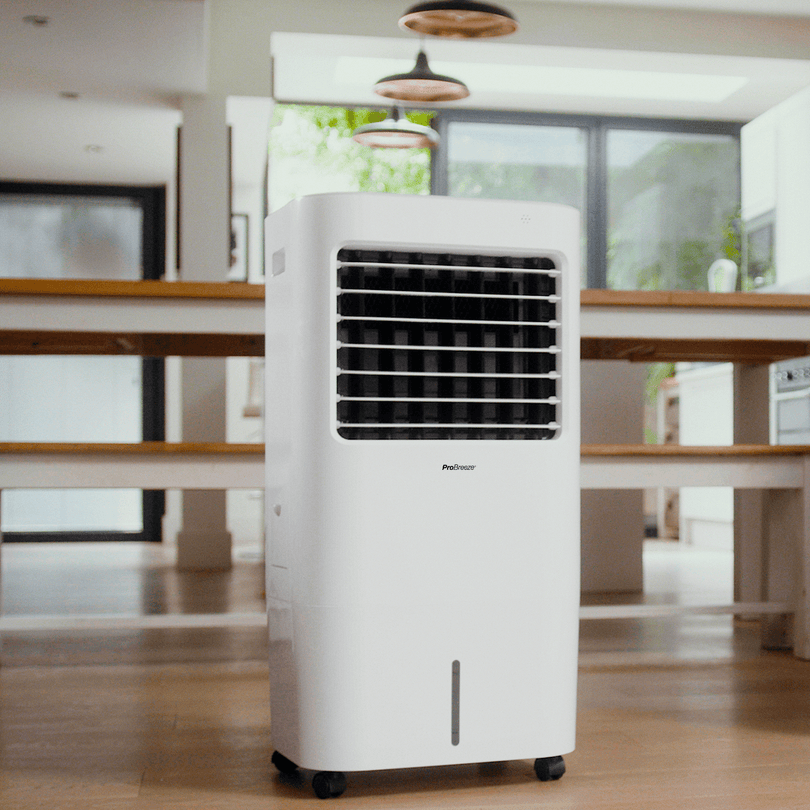
We no longer sell standalone air purifiers. Our air-purifying products are the AeraDry 2-in-1 and our bladeless tower fans with a built-in HEPA filter. They suit different homes, so here is an honest comparison.
| AeraDry 25L 2-in-1 | 32" bladeless fan and purifier | OmniAir 41" bladeless fan and purifier | |
|---|---|---|---|
| Best for | Rooms with both damp and dust or pollen | Small bedrooms and offices; cooling plus cleaner air | Living rooms and bedrooms; cooling and cleaner air with remote control |
| Purifying | HEPA H13, CADR 300 m³/h, air quality sensor | HEPA H13, CADR 70 m³/h | Pre-filter and HEPA H13 |
| Moisture removal | Yes: up to 25 L a day, 4 L tank | No | No |
| Also does | Laundry and night modes, Wi-Fi app | Bladeless cooling, 9 speeds, sleep mode | Bladeless cooling, 10 speeds, touch panel, remote and 12-hour timer |
Purifying and moisture removal are two different jobs
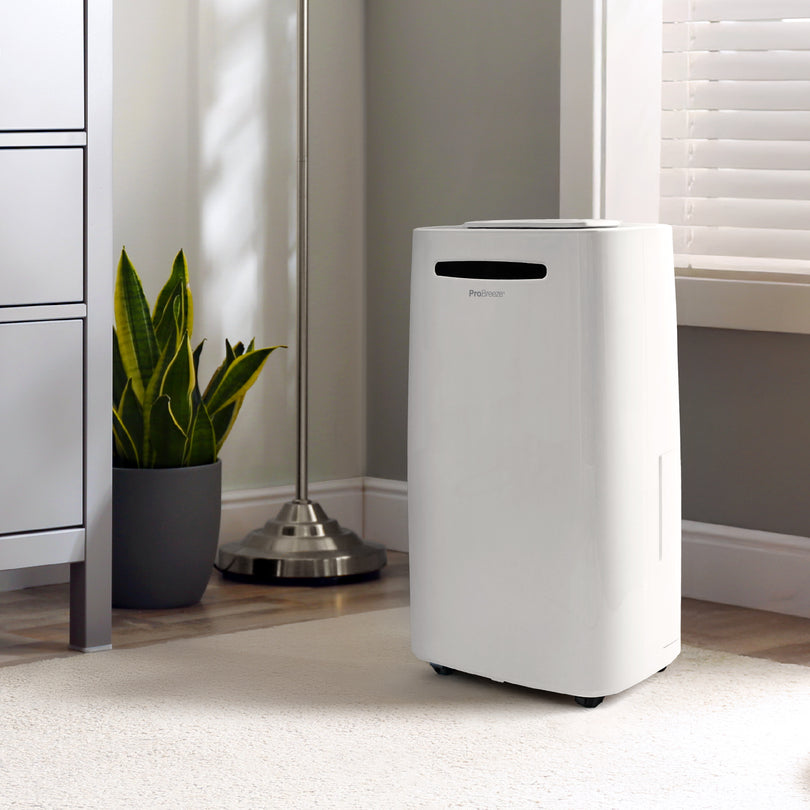
The AeraDry 25L True 2-in-1 Dehumidifier and Air Purifier combines a standalone HEPA 13 air purifier with a compressor dehumidifier. Use either on its own or both together: purify on a high-pollen day, dehumidify on a damp winter morning, or run both. It is the one to choose if condensation or drying washing is part of your problem as well as dust and pollen.
- Two machines in one, so one purchase tackles damp and airborne particles
- CADR of 300 m³/h: enough for large bedrooms and open-plan spaces
- Air quality sensor and Wi-Fi app control
- Bigger and heavier than a fan-style purifier
- Costs more per hour to run than a fan purifier when the dehumidifier is working

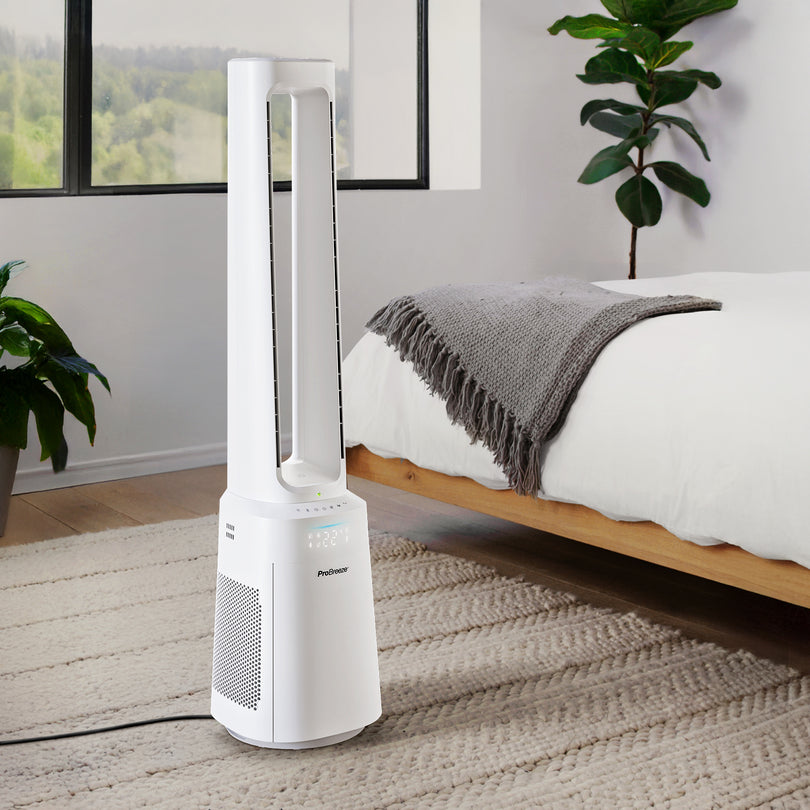
If cleaner air and cooling in the same room is what you are after, the 32" Bladeless Tower Fan and Air Purifier and the OmniAir 41" Bladeless Tower Fan and Air Purifier use a built-in HEPA H13 filter and cost around 1c an hour to run. They suit smaller rooms because their CADR is lower, they do not remove moisture, and not every bladeless fan has a purifier built in. Read more in our guide to bladeless fans.

AeraDry 25L True 2-in-1 Dehumidifier and Air Purifier with Air Quality Sensor and Smart App Control
4 549,00 kr
View product
5-in-1 Air Purifier with HEPA Filter with Negative Ion Generator
1 422,00 kr
1 479,00 kr
Browse our dehumidifier and air purifier range, or compare models in our 13-step guide to buying a dehumidifier if damp is the bigger worry. When it is time to change the filter, genuine replacement HEPA H13 filters for the AeraDry are available.
?Frequently asked questions
How do I choose an air purifier?
Work out your room’s volume, choose a CADR that gives at least 2 air changes an hour (4 if you have allergies or asthma in the household), look for a true HEPA H13 filter, and check noise, running costs and replacement filter prices. Add activated carbon if smoke or cooking smells matter.
What are the main kinds of air filter?
The main types are HEPA, activated carbon (charcoal) and ionic (negative ion). HEPA captures fine particles, carbon absorbs smells and gases, and ionic filters use charged ions to make particles drop out of the air. Pre-filters, cold catalyst and UV light are common extras.
What size air purifier do I need for my room?
Multiply the floor area by the ceiling height and by the air changes you want per hour. A 15 m² room with a 2.4 m ceiling needs about 72 m³/h for 2 changes an hour and about 144 m³/h for 4. Always compare CADR, not just a “suitable for” room size.
Do I need a dehumidifier as well as an air purifier?
Only if moisture is part of the problem. A purifier cleans particles out of the air but does not lower humidity, so condensation on windows, a damp feel or washing that will not dry points to a dehumidifier. The AeraDry combines both, and our 13-step dehumidifier guide helps you compare models.
Where should I put my air purifier?
In the room you spend the most time in, which for most people is the bedroom. Keep the air intake and outlet clear of curtains and furniture, and keep doors and windows closed so it cleans the same air.
Which air purifier is best for pet dander?
One with a pre-filter and a HEPA filter. The pre-filter catches pet hair and larger dander, and the HEPA filter captures the finer particles. Customers with pets often tell us this is the combination they notice most.
How often do I need to change the filter?
It depends on the model and how much you use it. The AeraDry’s HEPA H13 filter should be replaced about every 12 months and the OmniAir’s about every 6 months, and a washable pre-filter needs cleaning regularly. A filter change indicator takes the guesswork out.
Are air purifiers noisy?
They do not have to be. Noise depends on the model and the fan speed, so look at the decibel rating and choose one with a sleep or night mode for the bedroom.
How long should I run an air purifier?
Regular use helps reduce airborne particles. Lower fan speeds typically draw less power and make less noise. Follow the instructions in your product’s manual.
Do air purifiers help with mould?
A HEPA filter can capture mould spores that are floating in the air, but it does not stop mould growing on a damp wall or window frame, because mould needs moisture. To tackle the cause, keep humidity in check: see our guide to dehumidifiers for condensation and mould.
An air purifier is one of the simplest ways to keep the air in your home fresher, and, by capturing airborne dust, pollen and pet dander, a suitable purifier can help make the bedroom feel fresher and reduce exposure to those airborne triggers, which matters especially for family members with allergies. Match the CADR to the room, choose a true HEPA H13 filter, and check the running costs, and you will have clean air without the surprises. Not sure whether you also have a damp problem? Our guide to the benefits of an air purifier explains what an air purifier can and cannot do, and the AeraDry is there when you need both jobs done.