The quick answer
- Running cost = watts ÷ 1,000 × hours × your electricity price per kWh. Use the cooling input on your appliance’s rating label or in its manual.
- At €0.28 per kWh, the Pro Breeze models below cost about 27–44 cents per hour at rated cooling power. Eight hours at that power works out to about €2.15–€3.53.
- For a budget based on your home, use your own tariff and measure how many kilowatt-hours the air conditioner uses over a typical cooling session.
- Work out your cost or compare the 9,000, 12,000 and 14,000 BTU models.

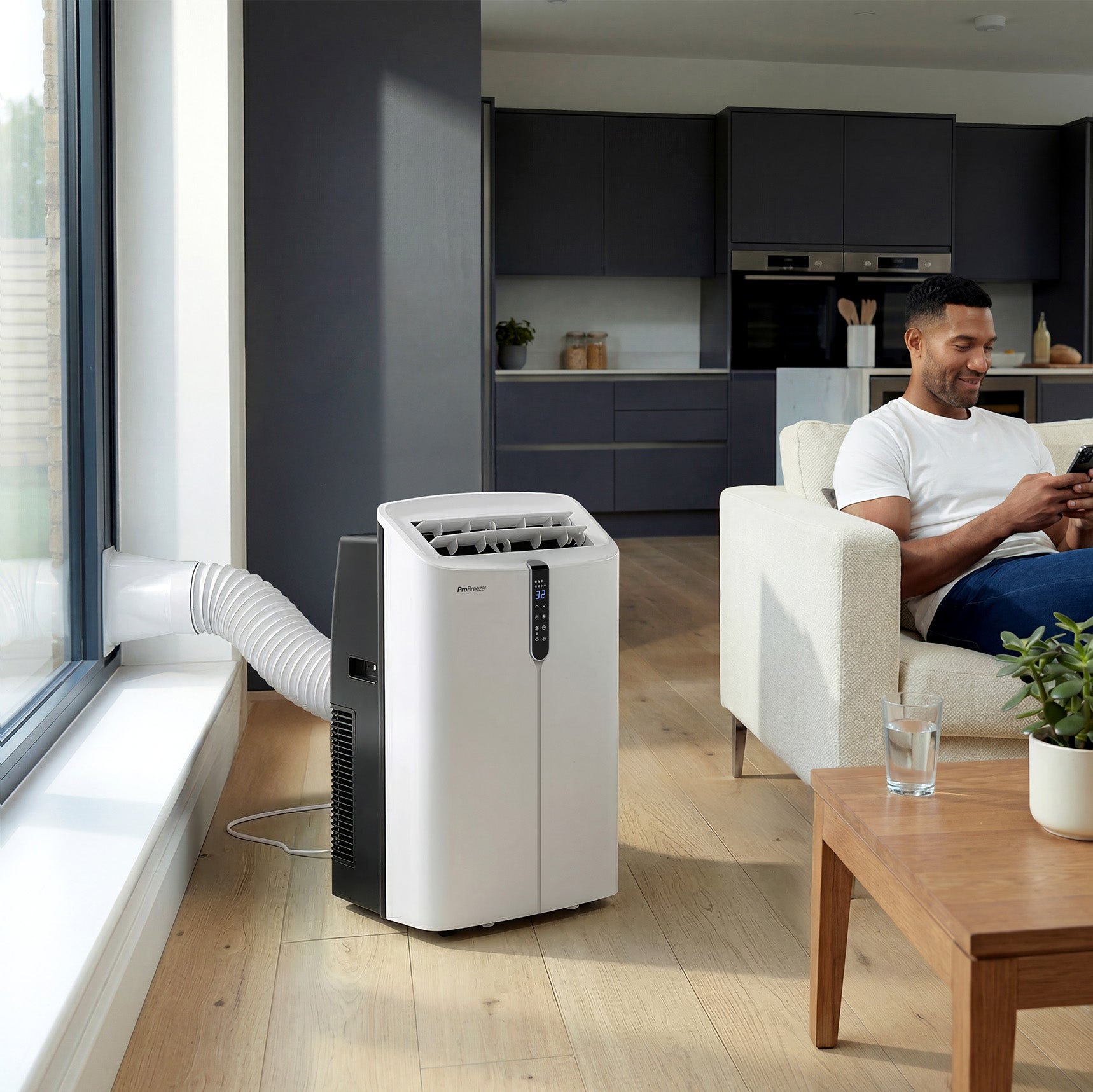
Portable air conditioner running costs depend on the power your unit draws, how long you use it and what you pay for electricity. A 12,000 BTU Pro Breeze model with a 1,350 W cooling input costs about 38 cents for one hour at rated power on a €0.28 per kWh tariff. Use the same calculation for any model, or start with the examples below and adjust them to your home.
1How to calculate portable air conditioner running costs
Cost = cooling input in watts ÷ 1,000 × hours × electricity price in euros per kWh.
- Find the cooling input. Look for “Cooling Power”, “Rated Input” or “Cooling Rated Input Power” on the rating label or in the specification section of your manual.
- Convert watts to kilowatts. Divide watts by 1,000. A cooling input of 1,350 W is 1.35 kW.
- Multiply by your cooling hours and tariff. Four hours at 1.35 kW uses 5.4 kWh at rated power. At €0.28 per kWh, that works out to €1.51.
Watts (W) measure the rate at which the appliance draws electricity. Kilowatt-hours (kWh) measure the amount of electricity used over time, which is what appears on your bill. The BTU figure indicates how much heat the air conditioner can remove per hour. Use electrical input in watts for the cost calculation and BTU for choosing cooling capacity.
2What do 9,000, 12,000 and 14,000 BTU models cost to run?
These examples use cooling input from the EU manuals and the same tariff for every model. The four-hour and eight-hour columns show two example daily budgets at rated cooling power. Actual use depends on how the unit operates in your room.
| Pro Breeze EU model | Rated cooling input | Per hour | Per 4-hour day | Per 8-hour day |
|---|---|---|---|---|
| 9,000 BTU 3-in-1 Smart | 960 W | 26.9 cents | €1.08 | €2.15 |
| 12,000 BTU 3-in-1 Smart | 1,350 W | 37.8 cents | €1.51 | €3.02 |
| OmniCool™ 12,000 BTU | 1,350 W | 37.8 cents | €1.51 | €3.02 |
| 14,000 BTU 3-in-1 Smart | 1,575 W | 44.1 cents | €1.76 | €3.53 |
Figures use €0.28 per kWh, the rounded Eurostat EU household electricity average for the first half of 2026. Each total is calculated from the wattage, then rounded. To budget for a month, multiply the unrounded daily figure by the number of days you expect to use cooling. For example, the 1,350 W model at rated power for four hours on each of 20 days uses 108 kWh, costing €30.24.
Start your model choice with the room size and how warm the room gets. The 14,000 BTU model is rated by Pro Breeze for rooms up to 35 m². Our portable air conditioner sizing guide explains how sunlight and layout affect the amount of cooling you need.
3Use the electricity price on your bill
Find the price per kWh on your electricity bill or in your supplier’s app. Use the variable price you pay, including applicable taxes and per-kWh charges. Leave fixed charges out of the calculation because you pay those regardless of how many hours you cool.
For example, the 1,350 W model uses 10.8 kWh over eight hours at rated power. At €0.24 per kWh, the rounded Dutch household average, that costs €2.59. At €0.36 per kWh, the rounded Belgian average, it costs €3.89. The model and electricity use are the same in both examples.
| Country | Euro per kWh | Country | Euro per kWh |
|---|---|---|---|
| Austria | €0.33 | Belgium | €0.36 |
| Czechia | €0.29 | France | €0.25 |
| Germany | €0.36 | Ireland | €0.39 |
| Italy | €0.31 | Netherlands | €0.24 |
| Poland | €0.30 | Portugal | €0.24 |
| Spain | €0.25 | EU average | €0.28 |
These rounded Eurostat household figures are a reference. With a time-of-use tariff, apply each price to the electricity used during that time window. Add the costs together for the total.
4Why your actual running cost can vary
In cooling mode, the compressor moves heat out of the room. On models that cycle the compressor, it can pause once the room reaches your target temperature and start again as the room warms. The fan may continue using some electricity during that pause. Eight hours of cooling mode can therefore use less energy than eight hours at rated input.
A sunny room with a lot of glass, a large gap around the exhaust hose or a very low temperature setting can make the compressor work for longer. The model, fan setting and weather also affect your reading. If you use dry mode on humid days, measure it separately. Our guide to a portable air conditioner with a dehumidifier mode explains when each mode is useful.
5Measure the cost of a cooling session
If your manual permits a suitable plug-in energy meter, choose one rated for your model and follow both sets of instructions. Record the meter’s starting and ending kWh readings, then subtract the starting value. You can also use smart-meter data to estimate the change by comparing similar periods and accounting for other appliances.
For example, if the meter records 7.2 kWh over a cooling session, multiply 7.2 by €0.28 to get about €2.02. Compare your readings on similar days, with the same room and temperature setting, if you want to see whether a change to your setup helps.
6How to get more from each cooling hour
- Keep hot exhaust outdoors. Fit the hose and seal the opening as your manual describes. Our portable air conditioner installation guide shows how to match the setup to common window types.
- Reduce heat coming into the room. Shade sunny windows early in the day and close doors to rooms you do not need to cool.
- Choose a comfortable temperature. A lower target gives the compressor more work. Start with a setting that feels comfortable and adjust from there.
- Keep airflow clear. Clean the filter as the manual describes and follow the model’s setup instructions so air can move freely.
If a breeze is enough for your room, a fan or evaporative air cooler may use less electricity. See our air cooler vs portable air conditioner guide to compare what each option does.
7Frequently asked questions
How much does a portable air conditioner cost to run per day?
At €0.28 per kWh, four hours at rated cooling power costs €1.08 for the 9,000 BTU model, €1.51 for the 12,000 BTU models in the table and €1.76 for the 14,000 BTU model. Use your own hours and tariff for an estimate specific to your home.
Will every 12,000 BTU air conditioner cost the same to run?
Check the cooling input for the exact model. Two units can have the same BTU rating and different electrical inputs. Room conditions and compressor run time can also make their measured electricity use differ.
Can I use the kWh figure on the energy label?
Yes, if the label gives a cooling value for a stated period. Multiply that energy figure by your tariff to estimate the cost for that test period. The actual kWh you measure in your room reflects your own settings and conditions.

9000 BTU 3-in-1 Portable Air Conditioner with Dehumidification Function - Smart Wifi App
€254,99
€429,99

12,000 BTU 3-in-1 Portable Air Conditioner with Dehumidification Function - Smart Wifi App
€339,99
€529,99

OmniCool™ 12,000 BTU 3-in-1 Ultra-Quiet Portable Air Conditioner with Dehumidification Function - Smart Wifi App
€389,99
€599,99
Choose the cooling capacity your room needs, then use the electrical input and your tariff to compare costs. Explore our portable air conditioners to compare the models.