The quick answer
- How quiet is quiet enough? Look for around 36–38 dB. The OmniDry 12L and 20L are Quiet Mark certified at 36 dB. See what dB means.
- No compressor at all? A desiccant model is quieter than compressor models. Compare the two.
- Features worth having: a 24-hour timer, a humidistat and a sleep mode. See what to look for.
- What it costs: from €0.04 an hour, or €0.36–€0.74 for a full 8-hour night at rated power across the OmniDry 10L, 12L and 20L models shown here. See the costs.

For a bedroom, look at the noise rating, timer settings and room size. A quiet model can reduce window condensation and musty smells. Here is what to look for, with costs based on eight hours at rated power.
1What do dB levels mean at night?
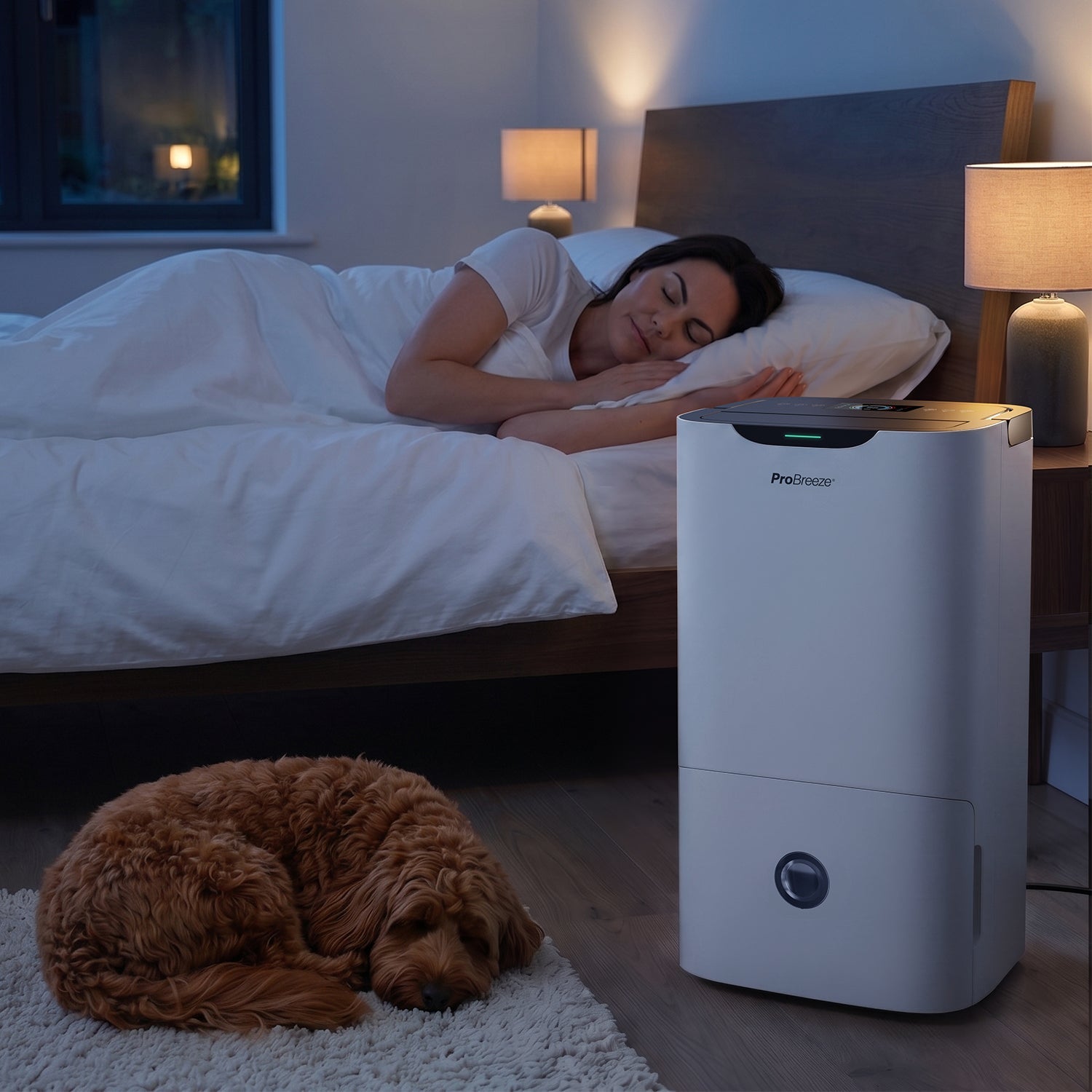
As a rule of thumb, a whisper sits at around 30 dB, a quiet library at around 40 dB and a normal conversation at around 60 dB. Our OmniDry 12L and 20L are rated at 36 dB, and both are Quiet Mark certified, so they sit between a whisper and a quiet library.
Two things matter beyond the number. A sturdy, level surface can help cut vibration and rattling. A steady fan hum is generally less noticeable than a rattle. And a bedroom is quiet at night, which is why the World Health Organization’s night noise guidelines for Europe link night-time noise with disturbed sleep.
2Compressor or desiccant: which is quieter?
| Compressor | Desiccant | |
|---|---|---|
| How it removes moisture | Cools a coil so water condenses | Absorbs moisture with a drying material |
| Noise | Quiet a compressor and a fan | Quieter no compressor |
| Running cost | Low €0.04–€0.09 an hour for the compressor models in the cost table below | Higher €0.17 an hour for the 10L |
| In a cold bedroom | Rated from 5°C | Rated from 1°C |
Power, working temperatures and noise: Pro Breeze product specifications. Running costs at rated power and €0.28 per kWh (Eurostat EU average).
Both types suit a bedroom. A compressor model is the best all-rounder: our OmniDry range is Quiet Mark certified and costs just cents a night. For the quietest running, our 10L Desiccant has no compressor, so it is quieter than compressor models, and it works down to 1°C for chilly rooms. For more detail on both types, see our 13-step guide to choosing a dehumidifier.
3Night modes, timers and humidistats
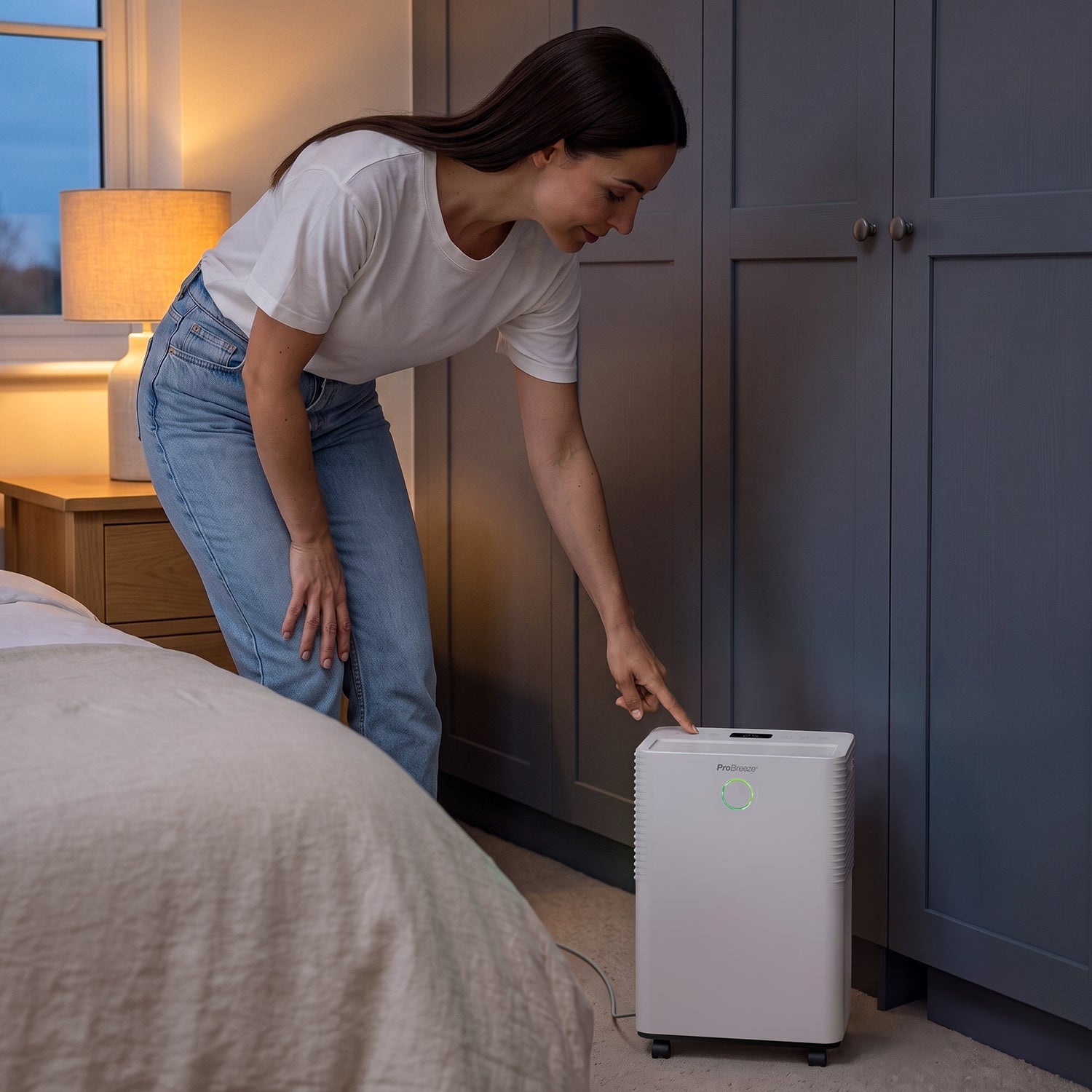
- Sleep or night mode. The 20L Max Extraction has a display-off setting that turns out the lights while the unit continues working; choose the fan speed separately. The AeraDry 25L has Sleep and laundry modes too.
- A timer. The OmniDry 12L, 20L and 40L and the 12L with Built-in Humidistat have a 24-hour timer, so you can set when it switches off.
- A humidistat. You set the humidity you want and the dehumidifier holds it. We recommend 40–60% for a bedroom. The OmniDry 12L and 20L Max Extraction both have automatic humidity control.
- Smart app control. The OmniDry 20L works with the Pro Breeze app, Alexa and Google Home, so you can switch it on or off from your phone.
If condensation is your main worry, read our guide to using a dehumidifier for condensation and mould.
4Where to put a dehumidifier in a bedroom
- Use a firm, level floor. A wobbly surface turns a hum into a rattle.
- Keep some distance from the bed. Sound falls away with distance, so even an extra metre makes a noticeable difference.
- Leave at least 50 cm clear around the unit, and follow your model’s manual if it specifies a different clearance. Keep the intake and outlet away from curtains and bedding.
- Close the door so the dehumidifier works on one room and reaches your target sooner.
5What tank size do you need for a bedroom?
The litres-a-day figure is the most a dehumidifier can remove in very damp air, so in a typical bedroom it will often collect less than the headline suggests. Even so, once a tank is full the dehumidifier cannot collect any more water. The OmniDry 12L (2 L), OmniDry 20L (4 L) and 12L with Built-in Humidistat (1.8 L) each come with an additional hose, and the 20L Max Extraction has a big 5.5 L tank. For continuous drainage, fit the hose as your model’s manual directs, with an unobstructed downhill route to a suitable drain below the outlet. Check the connection for leaks before use.
6Laundry mode and noise
Laundry mode keeps the dehumidifier running continuously at close to full power, instead of pausing when the room reaches its target humidity, so you hear a steadier fan. That steady airflow helps dry washing faster. Where available, sleep mode offers a quieter setting for general humidity control.
7What size dehumidifier for a bedroom?
Most bedrooms are small, so a compact model is often all you need. Go one size up if the room is damp or you dry laundry in it.
| Model | Noise | Room size | Tank |
|---|---|---|---|
| OmniDry 10L | 38 dB | Up to 12 m² | 1.7 L |
| OmniDry 12L | 36 dB | Up to 20 m² | 2 L |
| 12L with Built-in Humidistat | 38 dB | Up to 20 m² | 1.8 L |
| OmniDry 20L | 36 dB | Up to 30 m² | 4 L |
| 20L Max Extraction | 38 dB | Up to 30 m² | 5.5 L |
Noise, room sizes and tank sizes: Pro Breeze product specifications.
Browse every model in our bedroom dehumidifiers collection, or see the OmniDry family guide.
8How much does it cost to run overnight?
This table estimates eight hours of continuous operation at each model’s rated power. It is not a maximum-use guarantee: power varies with operating conditions, and a humidistat can pause moisture extraction once the room reaches the target.
| Model | Power | Cost per hour | 8-hour night |
|---|---|---|---|
| OmniDry 10L | 160 W | €0.04 | €0.36 |
| OmniDry 12L | 200 W | €0.06 | €0.45 |
| OmniDry 20L | 330 W | €0.09 | €0.74 |
| 20L Max Extraction | 320 W | €0.09 | €0.72 |
| 10L Desiccant | 620 W | €0.17 | €1.39 |
Costs at rated power and €0.28 per kWh: the Eurostat EU average electricity price for household consumers (first half 2026, including all taxes). Your tariff may differ. Power: rated power from Pro Breeze product specifications.
Electricity rates vary across Europe. Using the Eurostat EU average of €0.28/kWh (first half 2026, household including taxes), costs in your country may be higher or lower:
| Country | Electricity rate (€/kWh) |
|---|---|
| Ireland | €0.39 |
| Germany | €0.36 |
| Belgium | €0.36 |
| Austria | €0.33 |
| Italy | €0.31 |
| Poland | €0.30 |
| Czechia | €0.29 |
| Spain | €0.25 |
| France | €0.25 |
| Netherlands | €0.24 |
| Portugal | €0.24 |
For a model-by-model breakdown, read how much a dehumidifier costs to run.
9Best Pro Breeze dehumidifiers for a bedroom


OmniDry 20L Quiet Dehumidifier with Laundry Mode and Smart App Control
2 173,00 kr
2 516,00 kr

Every model above is in our bedroom dehumidifiers collection, where you can compare sizes, noise and features side by side.
10Frequently asked questions
How do the timer and tank-full shut-off work?
The off timer sets when the appliance stops, and tank-full shut-off stops dehumidification when the tank needs emptying. Follow the instructions in your product’s manual to check how these features work on your model.
What humidity should a bedroom be?
We recommend 40–60%. Above that, condensation and mould become more likely. For asthma or allergies, see our guide to creating an asthma-free bedroom.
Is a desiccant dehumidifier quieter for a bedroom?
A desiccant dehumidifier has no compressor, so it is quieter than compressor models. The trade-off is running cost: at 620 W it uses around €0.17 an hour at rated power. For most bedrooms an OmniDry gives the best balance of quiet and cost.
The best bedroom dehumidifier is one you forget is running: quiet, sized to the room and set to hold a steady 40–60%. Explore our bedroom dehumidifiers to find yours, and for more help choosing, see our 13-step buying guide.