The quick answer
- Most homes: a compressor dehumidifier is the best all-rounder for rooms kept above about 15°C.
- Cold spaces such as garages and outbuildings: choose a desiccant, which keeps working when it is cold.
- Size: 10–12 litres a day suits most bedrooms and living rooms. Go 20 litres or more for large rooms, very damp homes or laundry.
- Running cost: a modern compressor like the OmniDry 12L costs about €0.06 an hour to run.
- Not sure? See our picks by room.

- Start with the home problem. Condensation on windows? Run it in the bedroom or living room where the glass fogs up most. Indoor laundry? Choose a model with a good extraction rate for the room you dry in, ideally with a laundry mode or continuous drain. Damp or musty room? Focus on the room that feels heavy. Cold garage or outbuilding? Go for a desiccant.
- Match it to the room size. 10–12 litres a day suits most bedrooms and living rooms; go 20 litres or more for large rooms, very damp homes or laundry. See what size you need.
- Pick the type for the temperature. A compressor is the best all-rounder above about 15°C; a desiccant keeps working when it is cold. See types compared.
- Choose everyday features that fit your life: quiet running, tank size, continuous drainage and clear controls. See features to look for.
1Why damp happens
Damp is common during Europe’s cold, wet winters, and central heating makes it worse: warm air holds more moisture, which then condenses on cold windows and walls.
Cooking, showering and drying clothes indoors all add moisture. Combined with poor ventilation, high humidity leads to:
- black mould
- worse asthma and allergy symptoms
- damage to your home and belongings
- laundry that takes ages to dry
2Do you need a dehumidifier?
Common signs of high humidity:
- Condensation on windows
- Mildew spots or black mould on walls
- A musty smell in some rooms
- Peeling wallpaper or rotting wood
- Watermarks in basements or cellars

Basements, bathrooms, kitchens and attics are hotspots for high humidity. To be sure, measure it: a digital hygrometer costs under €15 and shows the humidity in a room. The ideal level is 30–50% in summer and 30–40% in winter. Black mould starts to grow at around 50% humidity, and when it comes to black mould, prevention is definitely better than cure.
Tips for reducing humidity
- Open windows or turn on extractor fans when cooking or showering
- Use lids on pans when boiling food to reduce steam
- Dry clothes outside, or open windows when drying indoors
- Move houseplants out, as they release water vapour
- Heat the room with a radiator
- Make sure your washing machine or tumble dryer isn’t leaking and is venting properly
- Open your bedroom window in the morning to release moisture from breathing overnight
- Dry clean rugs, as they collect moisture
- Seal cracks with caulk or sealant
- Use charcoal or rock salt to absorb moisture
Some of these won’t be possible for you, or the problem may be too severe, but it’s not the sort of problem you can comfortably ignore. Buying a dehumidifier is a good way to prevent the conditions that lead to black mould.
Read our full guide to using a dehumidifier for condensation and mould, with the right humidity level and where to put it in every room.
3How dehumidifiers work

Works like a fridge
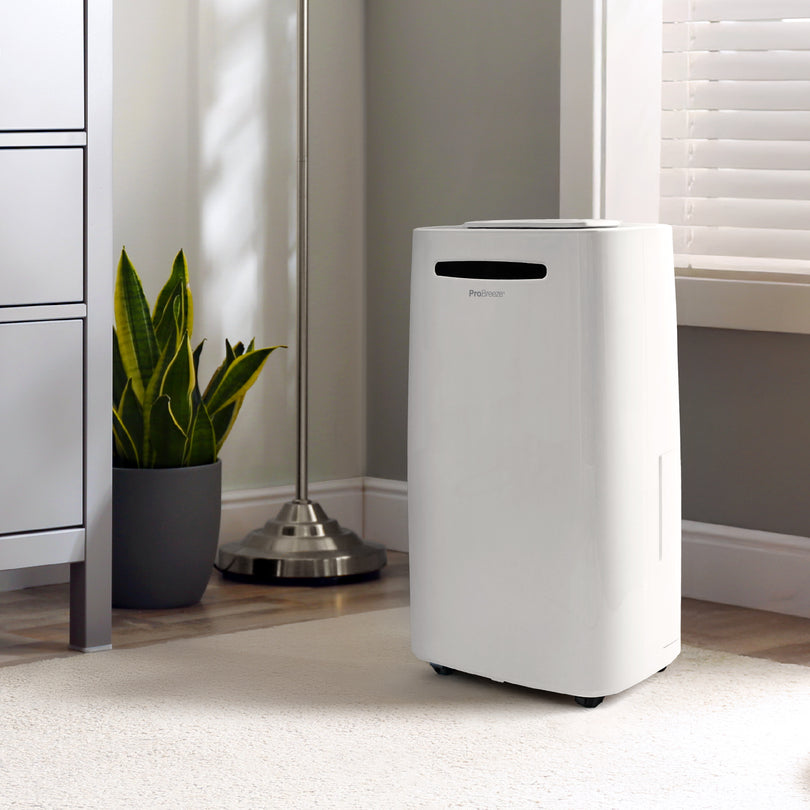
A fan draws air over very cold coils. Moisture condenses into the tank and drier, slightly warmer air returns to the room. The compressor chills much larger coils than a mini model, so it collects far more water.
Shop compressor models
Absorbs moisture
Air passes over a rotating wheel of absorbent material, which a heater dries out. It releases warm air, which helps in cold rooms.
Shop desiccant models
Small and simple
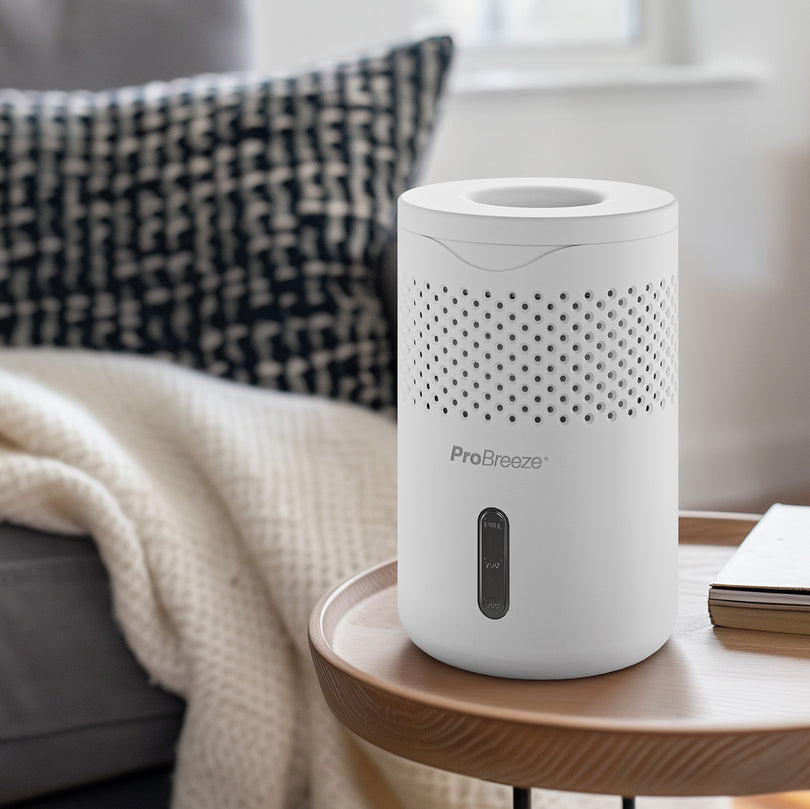
An electric cold plate condenses moisture without a compressor. Quiet and cheap to run, for small spaces only.
Shop mini models4What size dehumidifier do you need?
“Size” means how much water it can remove in 24 hours, not how big it is. Domestic dehumidifiers range from about 250 ml up to 20 litres or more a day; the smallest (0.25–1.5 litres) are useful for a single small room, a boat or a caravan. Choose by room size and temperature first, then allow for heavy moisture or laundry: litres per day alone don’t determine coverage. Go bigger if you have a large home, want to dry out a large room (choose 10–20 litres) or conditions are wetter (stains on walls, condensation, wet floors).
| Room size | Our pick | Removes up to | Ideal for |
|---|---|---|---|
| Up to 12 m² | OmniDry 10L | 10 L/day | Box rooms, small bedrooms, student rooms |
| Up to 20 m² | OmniDry 12L or 12L Compact | 12 L/day | Double bedrooms and most living rooms |
| Up to 30 m² | OmniDry 20L | 20 L/day | Large rooms, damp flats and drying laundry |
| Up to 50 m² | OmniDry 40L or 30L Max Extraction | 40 L / 30 L a day | Whole floors, open-plan spaces and very damp homes |
| Cold spaces up to 35 m² | 10L Desiccant | 10 L/day | Garages, outbuildings and unheated rooms (works from 1°C to 40°C) |
| Small spaces | Mini range or Osmo® absorber | 0.25–0.5 L/day | Wardrobes, cupboards and caravans |
Litres per day. Extraction rates are measured in test conditions (typically 30°C and 80% humidity); real homes are cooler and drier, so treat the figures as a guide.
5Water tank size
The tank holds the water collected and is usually smaller than the daily extraction rate. A bigger tank means fewer trips to empty it. Many compressor and desiccant models also have a continuous drainage outlet: attach a hose to a drain and it never needs emptying.
6Compressor, desiccant or Peltier?
Best for most homes
Typical capacity 10–40 L/day
- The most common type, and widely available
- Removes the most water in warm, humid rooms
- Lowest running cost for its capacity, and more efficient than a desiccant above 15°C
- Usually a higher capacity than an equivalent desiccant
- High performance in an average home at room temperature
- Loses performance below about 15°C
- Tend to be louder than a desiccant
- Heavier than other types
Best for cold spaces
Typical capacity 7–12 L/day
- Works well in low temperatures
- Quieter than compressors
- No cold coils to freeze, so no defrost pauses in cold rooms
- Lighter and easy to move around
- Gives off warmth while running
- Uses more electricity than a compressor
- Performance drops above room temperature
Best for small spaces
Typical capacity 0.25–0.5 L/day
- Very cheap to buy and run, using very little electricity
- Our quietest dehumidifiers, from just 33 dB
- Work very well in small rooms and cupboards
- Little to no maintenance
- Light and portable: move them with no interruption
- Removes moisture more slowly than compressors and desiccants
- Not suitable for large rooms (above about 220 sq ft)
- Struggle in very high humidity
- Poor below about 15°C
How temperature affects compressor models
| Room temperature | Compressor performance |
|---|---|
| 15–30°C | Ideal |
| 10–15°C | Reduced |
| 5–10°C | Poor: consider a desiccant |
| Below 5°C | Not recommended: use a desiccant |
Example: a centrally heated house at around 21°C, with condensation from showers and drying clothes, suits a compressor. A garage at 5°C in winter suits a desiccant: there, an 8–10 litre desiccant will outperform a much larger compressor model. And a small, warm bedroom with window condensation and a few spots of mildew is ideal for a mini Peltier model.
Got a garage, conservatory or outbuilding? See our guide to choosing a dehumidifier for a cold room or garage.
7Running costs
A common myth is that compressor dehumidifiers are expensive to run. In fact they use the least electricity for the water they remove.
Desiccant models use more power because they heat their drying wheel, which is why they suit cold spaces where that warmth is useful.
| Model | Type | Power | Per hour | Per day* | Per week* |
|---|---|---|---|---|---|
| Typical mini | Peltier | 23 W | <€0.01 | €0.08 | €0.54 |
| OmniDry 10L | Compressor | 160 W | €0.04 | €0.54 | €3.76 |
| OmniDry 12L | Compressor | 200 W | €0.06 | €0.67 | €4.70 |
| OmniDry 20L | Compressor | 330 W | €0.09 | €1.11 | €7.76 |
| 10L Desiccant | Desiccant | 620 W | €0.17 | €2.08 | €14.58 |
*12 hours a day at full power (each model’s rated power from Pro Breeze product specifications: rating label, at 27°C/60% RH where stated), at €0.28 per kWh: the Eurostat EU average electricity price for household consumers (first half 2026, including all taxes). Actual costs are usually lower, because units with a humidistat rest once the room reaches your target. Laundry mode is the exception: it runs non-stop until its timer (1–24 hours) ends or the tank is full. Your tariff may differ.
Electricity rates vary across Europe. Using the Eurostat EU average of €0.28/kWh (first half 2026, household including taxes), costs in your country may be higher or lower:
| Country | Electricity rate (€/kWh) |
|---|---|
| Ireland | €0.39 |
| Germany | €0.36 |
| Belgium | €0.36 |
| Austria | €0.33 |
| Italy | €0.31 |
| Poland | €0.30 |
| Czechia | €0.29 |
| Spain | €0.25 |
| France | €0.25 |
| Netherlands | €0.24 |
| Portugal | €0.24 |
Want the figures for other models? See dehumidifier running costs by model: per hour, per day and per month.
How a dehumidifier can save you money
- Dry air feels warmer, so many people can turn the thermostat down a degree.
- Drying laundry with a dehumidifier uses a fraction of the energy of a condenser or vented tumble dryer.
- No more buying expensive anti-mould cleaning products.
- Less damp damage to your home and belongings that you’d otherwise have to pay to fix.
- Dry air takes less energy to heat, so your heating works less hard.
- Less need to open windows for ventilation, so fewer energy-wasting draughts in winter.
- Desiccants give out warm air, so they can double up as a heater in cold rooms.
Use your dehumidifier efficiently and only when you need it, and you’re likely to save money overall, or at least break even.
8Features worth looking for
Humidistat
Set a target humidity and it switches on and off automatically, saving energy.
Laundry mode
Runs at maximum to dry washing indoors quickly, a cheaper alternative to a condenser or vented tumble dryer. It keeps going until its timer ends or the tank is full.
Drying clothes indoors with a dehumidifier: our step-by-step guide.
Continuous drainage
Attach a hose so the tank never needs emptying. Ideal for cellars and long runs.
Low noise
Check the decibel rating for bedrooms. Our OmniDry range runs from 36 dB.
Auto shut-off and restart
Stops when the tank is full and remembers your settings after a power cut.
Smart app control
Check humidity and change settings from your phone on selected models.
Built-in hygrometer
Measures the room’s humidity so the unit can switch itself on and off.
Defrost mode
Stops the coils freezing up in cooler rooms.
Handle and castor wheels
Essential on larger units (over 8 litres) so you can move them room to room.
Automatic shut-off stops the dehumidifier when the tank is full. A continuous drainage outlet can send collected water directly to a drain, which is useful in damp basements. Follow the instructions in your product’s manual.
9How to use a dehumidifier
When drying out a room for the first time, run it for longer (from 8 hours up to several days, depending on how damp it is and your dehumidifier’s capacity). Once you reach your target (for example 50%), 2–4 hours a day is usually enough to maintain it, and you may not need it at all times of year. With an adjustable humidistat set to your target, it only switches on when humidity rises. The best setting: 30–50% in summer and 30–40% in winter.
- Vacuum first, so you don’t spread dust or clog the vents.
- Keep doors and windows closed while it runs, and block off other sources of moisture.
- Stand it on a stable, even surface.
- Leave at least 15 cm around it, away from walls.
- Place it centrally, or on the landing to treat a whole floor.
- For condensation or a damp wall, place it near the problem.
- Stand a new compressor model upright for an hour before first use.
- Plug directly into a wall socket, not an extension lead.

10Maintenance and warranty
All models
- Unplug before cleaning
- Empty the tank regularly
- Wash the tank every two weeks in warm soapy water
Compressor
- Clean the filter regularly
- Wipe dust off the coils to keep it efficient
- If coils ice up, the room is too cold: raise the unit, warm the room or use a desiccant
Desiccant and mini
- Clean the filter with soap and warm water when dust builds up, at least every two weeks in regular use
- Vacuum antibacterial filters
- Brush the vents to keep air flowing
Read the instructions: they’ll tell you the best way to clean your filter and tank. Look after your dehumidifier and it should last a long time. If something does go wrong, every Pro Breeze product comes with a two-year limited warranty. Keep your receipt somewhere safe. See our warranty policy for full details.
11Your budget
| Type | Typical price | Best for |
|---|---|---|
| Mini (Peltier) | €30–€60 | Wardrobes, cupboards, caravans, small rooms |
| Compressor | €75–€400 | Bedrooms, living rooms, whole homes, laundry |
| Desiccant | Around €200 | Garages, outbuildings, unheated rooms |
Many people are put off because they think a dehumidifier is a big investment, but mini models cost from around €30 to €55 and are very cheap to run. More powerful models cost more, though not always, which is why it pays to compare. Buy the right size for your space and you’ll get the most from your budget, and save money by stopping damp, mould and drying costs before they build up.
12Recalled models to avoid second-hand
Faulty dehumidifiers can be a fire risk. These older models were recalled and should not be on sale, but watch for them second-hand:
| Brand and model | Model number | Recalled |
|---|---|---|
| Argos 10 L | DHMD102 | 2016 |
| Dimplex | DXDH10N / DIMOC - DH212 | 2016 |
| B&Q Airforce 20 L | BQDC20 | 2014 |
| Boots Mini Dehumidifier | 47-15-187 | 2005 |
| DH30 Drydamp | 007001 to 014030 | 2002 |
| Ebac 880e | Starting with 11489 | 2000 |
For current recalls, check the European Commission Safety Gate or the UK government’s product safety alerts and recalls.
13Which Pro Breeze dehumidifier should you buy?


OmniDry 20L Quiet Dehumidifier with Laundry Mode and Smart App Control
2 161,00 kr
2 502,00 kr

OmniDry 40L Quiet Low Energy Dehumidifier with Laundry Mode and Smart App Control
2 502,00 kr
3 071,00 kr
Compare every model on our dehumidifiers page, or read Meet the OmniDry family.