The quick answer
- Set-up in minutes: place the unit by a window, fit the kit, attach the hose, seal the gap and plug in. See the six steps.
- Window kits included: every Pro Breeze model comes with a sliding kit and a hinged-window fabric kit. Find your kit.
- No window? A sliding door seal kit or an outside wall vent works. See your options.
- Not sure which size? Use our BTU room size chart.
- See our air conditioners.

Smart portable air conditioners often feel “intimidating” until you see how they work in a real home. The big idea is simple: the unit cools the room and vents warm air out, typically using a window kit with no permanent installation. This guide explains how to set up a Pro Breeze portable air conditioner, how to vent it through the windows you actually have, what to check before you buy and which models to consider.
1Why the hose has to go outside
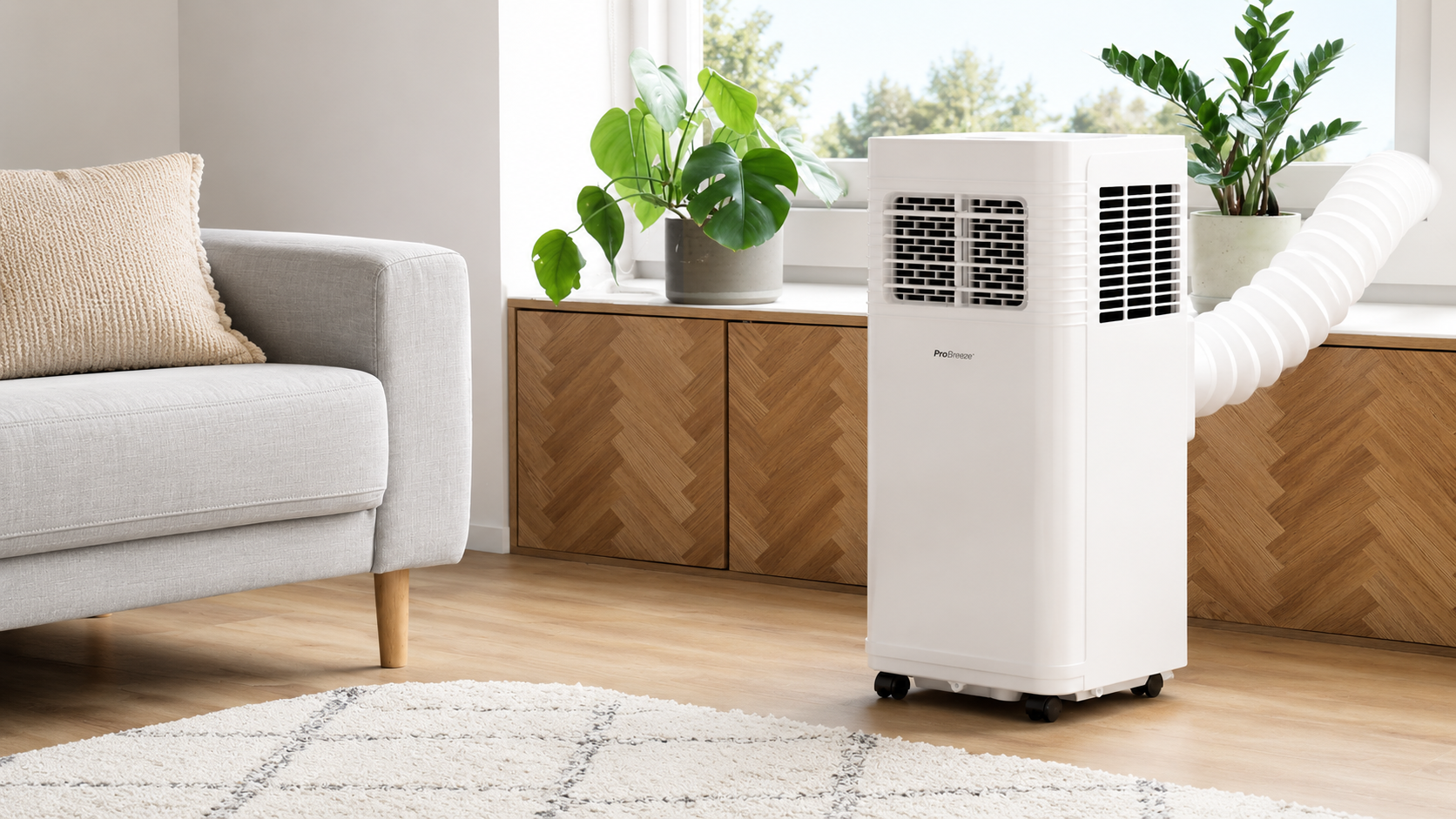
An air conditioner does not make heat disappear, it moves it. Warm air is pulled from the room, the heat is removed and then has to go somewhere. The hose carries it outside, so it must run to a window, door or wall vent, never into another room.
- The cooled air stays in your room; the hot exhaust air leaves through the hose.
- The window kit fills the gap around the hose so warm air from outside cannot flow back in.
- If the hose ends inside the room, the heat comes straight back in and you are cooling and heating the same room at once.
- Keep the hose as short and straight as you can. The hose is warm, and a long or kinked run gives off heat into the room and slows the airflow. Place the unit close enough to the window for the supplied hot-air exhaust hose to reach without stretching or sharp bends. Check the exhaust-hose instructions for your model; the water-drain hose is a separate part.

2How to set up a portable air conditioner
Place the unit near a window and a plug socket, fit the window kit that matches your window, attach the exhaust hose with no sharp bends and seal the gap around it. Give the unit space, plug in, choose cool mode and set your temperature. It usually takes minutes.
- Place it: near a window (and a plug socket) for easier venting.
- Choose the kit: pick the window kit that matches your window (see the next section) and fit it into the opening.
- Attach the hose: connect the vent hose to the back of the unit and to the kit as directed, with no sharp bends.
- Seal it: close the window kit around the hose so the gap is sealed.
- Power up: give the unit airflow clearance, plug in, pick cool mode and set your temperature.
- Close up: keep windows and doors closed while cooling for best results.
3Window kits for European windows
Sash (sliding) windows use the rigid sliding kit; casement and tilt-and-turn windows use the hinged-window fabric kit. Both are included with every Pro Breeze portable air conditioner. Sliding patio doors and large or awkward openings use separate kits, listed in the table below.
| Your window | Kit to use | Good to know |
|---|---|---|
| Sash (vertical sliding) | Sliding window kit (included) | Open the window just enough to fit the kit, then adjust it to the opening. |
| Casement (side or top hinged) | Hinged window fabric kit (included) | The adjustable zip closes around the hose, and the fabric can be removed and stored over winter. |
| Tilt-and-turn | Hinged window fabric kit (included) | These windows are hinged, so use the fabric kit and follow the fitting instructions in the box. Check the measurements and fitting instructions for your window before installation. |
| Sliding patio door | Universal Sliding Door Seal Kit | Designed for sliding doors; fits all portable air conditioner exhaust hoses. |
| Large or awkward opening | Universal Window Seal Kit (400cm) or 500cm Window Seal Kit | Extra-thick waterproof fabric for hinged windows. It reflects sunlight and heat and helps keep insects out. |
The fabric kits fit all portable air conditioner exhaust hoses and need no tools. Measure your window opening before ordering an extra kit.

4Can I use a portable air conditioner without a window?
Not without venting. A portable air conditioner always needs a way to send hot air outside, but that does not have to be a window. A door or a hole through an external wall will do. Never vent into the next room, a loft or a ceiling void.
- A door: the Universal Sliding Door Seal Kit vents through a sliding patio door, and the kit is removable.
- An outside wall: a vent through the wall works but is a permanent job. Use a professional, and in rented homes check with your landlord first.
- Not an option: venting into the next room, a loft or a ceiling void. This just moves the heat around your home.
- No way to vent at all? Look at an air cooler instead. It needs no hose, though it works differently and is best in dry air. See our guide to air coolers and air conditioners.
5Using your air conditioner: modes and controls
Pro Breeze air conditioners have cool, fan, dry (dehumidify) and sleep modes, a timer and a remote, and the smart models add app and voice control. Set the temperature, pick the mode and let the unit work. Check the instruction manual for your model for the full button guide.
- Cool: lowers the temperature to your set point, then the compressor cycles off to save energy.
- Dry: removes moisture on muggy days. Check your model’s continuous-drainage instructions before using Dry mode. See our guide to a portable AC with dehumidifier.
- Sleep and timer: sleep mode adjusts cooling for quieter operation, with settings that vary by model. The off timer sets when the unit stops.
- Smart control: the smart models work with the Pro Breeze app and voice commands, so you can cool the room before you get home.
6Before you buy: a 60-second home check
Check three things before you buy: the size of your room, a practical vent route for the hose and enough floor space for the unit to sit with clearance. A quick check prevents most set-up frustration and tells you which size of air conditioner to choose.
- Room size: choose the model designed for your space (check the product listing, or use our size guide).
- Window access: do you have a practical vent route?
- Floor space: make sure the unit can sit with clearance.
- Features that matter: sleep mode and timer for bedrooms, remote or smart app control, wheels if you’ll move it between rooms, and washable filters with easy maintenance access.
7Efficiency tips: cool the room faster for less
Seal the vent, shut the room and keep the sun out. These small steps help the unit reach the temperature sooner, so it works less. Start early, keep the hose short and straight, and clean the washable filter regularly so air flows freely.
- Seal the gap around the hose fully, so hot air can’t drift back in.
- Keep the hose short, straight and away from furniture.
- Close the curtains or blinds on sunny windows, and keep doors shut.
- Start early. Cooling a room before the hottest part of the day is easier than catching up.
- Use the built-in timer or smart schedule to switch the unit off when the room is empty.
- Clean the washable filter regularly so air flows freely.
- Pick the right size. A unit that is too small works flat out; see our size guide.
8Recommended Pro Breeze picks
Choose the 5,000 BTU for a small room, the 9,000 BTU for a living room or home office, the 12,000 BTU 3-in-1 for a larger room, the 12,000 BTU 4-in-1 for cooling and heating, or OmniCool for low-noise cooling. Check our size guide for each model’s room limit.
Every model below is a 3-in-1 (or 4-in-1) with window kits included, so you can set it up in minutes.

9000 BTU 3-in-1 Portable Air Conditioner with Dehumidification Function - Smart Wifi App
€254,99
€429,99

12,000 BTU 3-in-1 Portable Air Conditioner with Dehumidification Function - Smart Wifi App
€339,99
€529,99

OmniCool™ 12,000 BTU 3-in-1 Ultra-Quiet Portable Air Conditioner with Dehumidification Function - Smart Wifi App
€389,99
€599,99
Choosing between an air cooler and an air conditioner? Read our comparison guide. For hot nights, see our bedroom sleep cooling guide. Or browse our smart portable air conditioners and all cooling.
9Frequently asked questions
Do portable air conditioners need permanent installation?
No. They’re designed for practical home set-up, usually with a window kit for venting.
Can I use a portable AC in a rented home?
Often, yes, because set-up is typically non-permanent. Always follow the product instructions and your rental requirements.
How do I set up a Pro Breeze air conditioner?
Place it near a window and plug socket, fit the kit for your window type, attach the exhaust hose with no sharp bends, seal the gap, then plug in and choose cool mode. See the six steps above.
What size portable AC do I need?
Choose based on the room size in the product listing. If the room is larger or gets very hot, choose the size designed for that space. Our BTU room size chart makes it quick.
Why do some portable ACs also dehumidify?
Humidity affects comfort, and a dehumidifying function can help rooms feel lighter while cooling. See our portable AC with dehumidifier guide.
Does the hose have to go out of a window?
It has to go outside. A window is the easiest route, and a sliding door or an outside wall vent also work. Venting into another room or a loft only moves the heat.
Which window kit do I need for a sash window?
Use the sliding window kit supplied with your air conditioner. Casement and tilt-and-turn windows use the hinged window fabric kit, also supplied.
Can I make the hose longer?
It’s best not to. A longer hose gives off more heat into the room, so place the unit close to the window instead.