The quick answer
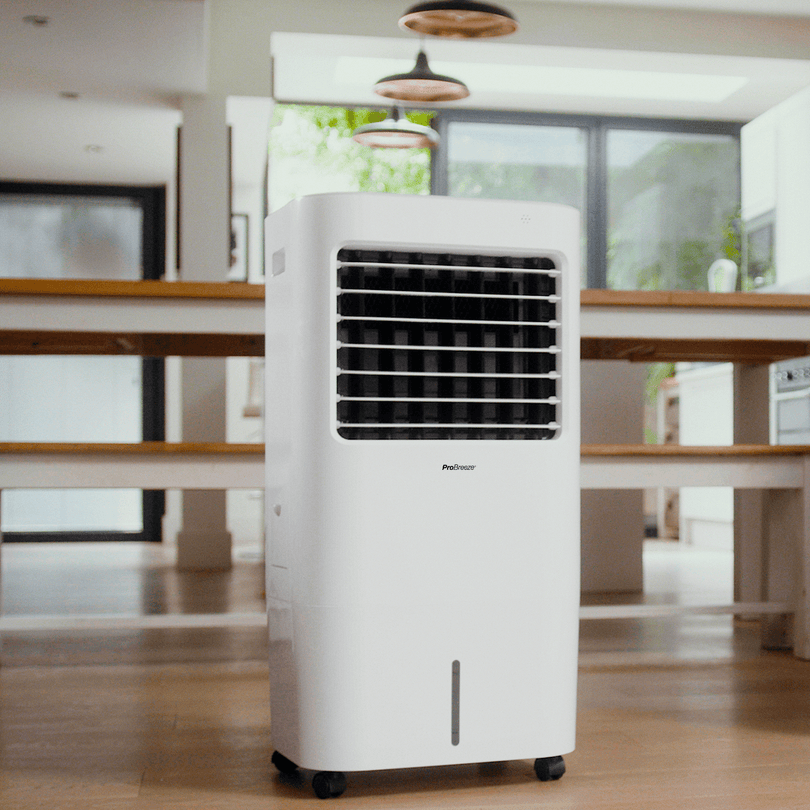
- Air cooler: a fan that blows air over water-soaked pads. It feels a few degrees cooler close by, costs about 1–2c an hour to run and needs no window kit.
- Air conditioner: uses a refrigerant, like a fridge, to genuinely lower the room temperature and dry the air. It costs more (about 28.0–44.1c an hour at full cooling for our models) and must vent hot air out of a window.
- Choose an air conditioner for hot bedrooms, home offices and heatwaves, especially on humid days.
- Choose an air cooler for a low-cost personal breeze, on dry days, with a window open.
- See our cooling range.

Ahhh, the summer months. Trips to the seaside, picnics in the park and… brutally hot weather! Once the mercury tops 25°C it can get stiflingly hot indoors, and sleeping becomes difficult for adults and children alike. An air conditioner or air cooler can really help ease the heat and make your home much more pleasant, but they’re very different machines. Here’s all you need to know to choose.
1Air cooler vs air conditioner: the key differences
They look similar and both blow cool air, but they work in completely different ways, and that changes how cool they make your room.
| Air cooler | Portable air conditioner | |
|---|---|---|
| How it cools | Evaporating water | Refrigerant gas |
| Lowers room temperature? | Slightly, close by | Yes, whole room |
| Humidity | Adds moisture | Removes moisture |
| Best on humid days? | No | Yes |
| Window kit needed? | No (but keep a window open) | Yes, exhaust hose to a window |
| Power use (our models) | 50–60 W | 1,000–1,575 W |
| Running cost per hour* | About 1–2c | About 28.0–44.1c at full cooling |
*Calculated at the Eurostat EU average electricity price of €0.28 per kWh (2026 first half household rate including taxes). See running costs.
2How an air cooler works
Air coolers have no compressor or refrigerant gas, so they’re smaller, lighter and cheaper than air conditioners. An air cooler (also called an evaporative cooler) draws warm air through a honeycomb pad kept wet from a cold-water tank, and an internal fan spreads the cooled air around. As the water evaporates it absorbs heat, so the air blown out is cooler. Adding ice packs to the tank cools the water further.
- Very cheap to run: about the same as a fan
- A refreshing, chilled breeze that blasts cool air where you sit
- No hose or window kit; easy to move
- Cheaper to buy; can double as a fan or humidifier
- Only a few degrees of cooling, felt mostly in the airflow
- Works less well as humidity rises, which is common in summer heatwaves
- Needs a window or door open, and regular refilling. If you can’t leave one open because of noise, insects or security, an air conditioner may suit you better

3How an air conditioner works
In many ways a portable air conditioner is like a fridge, but instead of keeping the cold inside, it blows it around the room. Refrigerant absorbs heat from the room air, which is blown back out cooler and drier. The heat removed is pushed outside through an exhaust hose fitted to a window, a vent or a dedicated opening.
- Genuinely lowers the temperature of the whole room
- Removes humidity, so it works well on sticky days
- Thermostat, timer and app control on smart models
- Costs more to buy and to run
- Needs a window nearby for the hose
- Louder than a fan; check the dB rating for bedrooms

4Running costs compared
| Model | Type | Power | Per hour* | 8 hours* |
|---|---|---|---|---|
| OmniAir 5L / 7L | Air cooler | 50–60 W | 1.4–1.7c | 11–13c |
| 9,000 BTU 3-in-1 Smart | Air conditioner | 1,000 W | 28.0c | €2.24 |
| OmniCool 12,000 BTU | Air conditioner | 1,350 W | 37.8c | €3.02 |
| 14,000 BTU 3-in-1 Smart | Air conditioner | 1,575 W | 44.1c | €3.53 |
*Calculated using the Eurostat EU average electricity price of €0.28 per kWh (2026 first half household rate including all taxes). An air conditioner’s compressor cycles off once the room reaches the set temperature, so real costs are often lower.
| Country | Electricity rate (€/kWh) | Country | Electricity rate (€/kWh) |
|---|---|---|---|
| Germany | €0.36 | Czechia | €0.29 |
| Ireland | €0.39 | Spain | €0.25 |
| Belgium | €0.36 | France | €0.25 |
| Austria | €0.33 | Netherlands | €0.24 |
| Italy | €0.31 | Portugal | €0.24 |
| Poland | €0.30 | EU Average | €0.28 |
Electricity rates source: Eurostat (nrg_pc_204, 2026 first half household electricity prices including all taxes).
5What size air conditioner do you need?
An air conditioner’s cooling power is measured in BTU (British Thermal Units). More BTU cools a bigger room. Based on our product specifications:
| Room size | Cooling power | Typical room |
|---|---|---|
| Up to 22 m² | 9,000 BTU | Bedrooms, small living rooms, home offices |
| Up to 30–35 m² | 12,000 BTU | Large bedrooms, living rooms |
| Up to 40–45 m² | 14,000 BTU | Open-plan living spaces, conservatories |
A 9,000 BTU air conditioner is a solid choice for most European homes: it packs a big enough punch to cool bedrooms, lounges and living areas without draining your bank account.
Go up a size for south-facing rooms, top-floor flats, conservatories or rooms with lots of glass. Air coolers aren’t rated in BTU.
Sizing an air cooler
Air coolers are sized by airflow, often given in CFM (cubic feet per minute) or m³/h. A common rule of thumb: multiply the floor area in square feet by the ceiling height in feet, then divide by two. That’s roughly the CFM you need. A cooler that’s too small for the space works flat out without keeping you cool. Our OmniAir coolers move 300–500 m³/h (about 175–295 CFM), ideal for cooling you in a bedroom, living room or home office.
6Features worth looking for
Dehumidifier mode
Many air conditioners have a Dry mode, useful on muggy days and in damp months.
Sleep mode
Raises the set temperature gradually overnight and runs more quietly.
App and voice control
Cool the room before you get home. Our smart models work with an app.
R290 refrigerant
A natural refrigerant with a much lower global warming impact than older gases. Used in our air conditioners.
Noise level
Check the dB rating. Our air conditioners range from 54 to 62 dB.
Ice packs (coolers)
Air coolers with ice packs give cooler air for longer.
Energy rating
Check the energy label: the higher the rating, the lower the running costs. A more efficient model may cost a little more at the outset but saves money in the long run. All our portable air conditioners are A-rated.
Timer and remote
The timer can schedule when the unit starts or stops. The remote adjusts settings from across the room, and smart models offer app control. Follow your product’s manual for timer settings.
Your budget
Air conditioners cost more to buy and use more electricity. If budget is tight, an air cooler gives low-cost relief; if you need a genuinely cooler room, an air conditioner is worth it.
7Pick by room problem
Not sure which to buy? Start with how the room actually feels. It is the fastest way to choose the right category, and it stops you paying for more cooling than you need.
| How the room feels | Choose | Why |
|---|---|---|
| Stale and stuffy | A fan | Keeps the air moving, for pennies an hour |
| Warm | An air cooler | A cooler, fresher breeze with no vent hose |
| Hot | A portable air conditioner | Noticeably cooler room, with simple window venting |
A fan makes you feel cooler by moving air; it does not lower the temperature of the room. Compare all three in our cooling range.
Match it to your routine
Cooling that fits your day is cooling you will actually use. Think about when you need comfort most.
- Hot nights: compare low-noise sleep modes and timers for bedroom cooling
- Home office: steady comfort and quiet running, so it never distracts you
- Moving between rooms: handles and wheels make a portable unit much easier to live with
Features that make it easy to live with
- Remote or smart app control
- Timer or scheduling
- Oscillation and adjustable speeds
- A size that fits neatly into your space
8Which should you buy?
- 9,000 BTU 3-in-1 Portable Air Conditioner: for bedrooms and living rooms up to 22 m², with Cool, Fan and Dehumidification modes and smart Wi-Fi app control.
- Portable air conditioners: from 5,000 to 14,000 BTU, using R290 refrigerant, with smart app control on selected models.
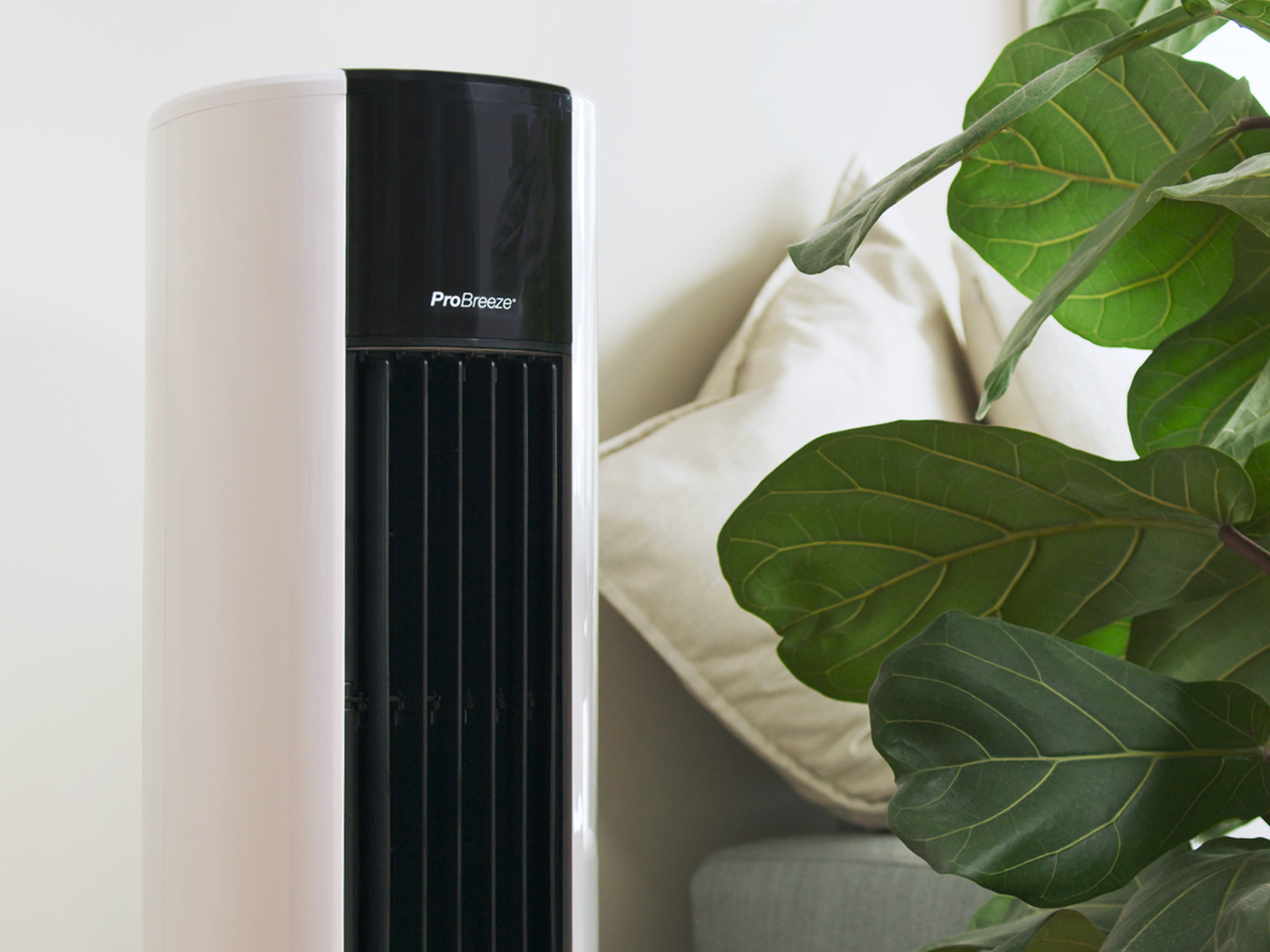
- Air coolers: OmniAir tower coolers with fan, night and humidification modes, using 50–60 W.
Recommended Pro Breeze picks
Whichever you choose, it can make your home a more pleasant, livable and healthy place in the heat of summer, and with European summers getting hotter, it will keep your family cool and happy for years to come. For damp rather than heat, see our 13-step guide to buying a dehumidifier.
9Frequently asked questions
Do air coolers really work?
Yes. They blow a genuinely cooler, refreshing breeze, a step up from a normal fan, for about the same running cost. They work best close by, on dry days, with a window open.
Is an air cooler as good as an air conditioner?
They do different jobs. An air cooler makes the air blowing at you feel a few degrees cooler for 1–2c an hour; an air conditioner lowers the temperature of the whole room and removes humidity. For the hottest bedrooms and heatwaves, choose an air conditioner.
Is an air cooler good for a bedroom?
An air cooler gives a gentle breeze at a low running cost. Our OmniAir coolers have a night mode and timer. For very hot bedrooms, a portable air conditioner can cool the whole room, and sleep mode offers a quieter setting.
Do air coolers work in Europe?
They work best on hot, dry days with a window open. During humid summer heatwaves the water evaporates more slowly, so the cooling effect is smaller.
Can an air cooler be used as a humidifier?
Yes. Most air coolers add moisture as they cool, and our OmniAir coolers have a humidification mode, handy if your air feels dry.
Does an air cooler need a window?
It doesn’t need a hose, but it works better with a window or door open, so the moist air it adds can escape.
Does a portable air conditioner need a window?
Yes. It must vent hot air outside through its exhaust hose, usually with a window kit. Without it, the room will warm up rather than cool down.
Are air coolers cheaper to run?
Yes, much cheaper: about 1–2c an hour, compared with about 28.0–44.1c for our air conditioners at full cooling at EU average rates.
Do fans cool a room down?
Fans improve airflow so the room feels more comfortable, but they don’t lower the temperature the way an air conditioner does.
What’s the easiest “no regrets” choice?
If the room is just stale, start with a fan. If it’s hot, choose a portable air conditioner. If you want a middle ground with low hassle, try an air cooler.
How do I choose the right size?
Use the room-size guidance on each product page. If you’re between sizes, it’s usually safer to choose the option designed for the larger space.